How Do Aluminum Cans Protect Flavor During Storage?
Views: 0 Author: Site Editor Publish Time: 2026-08-10 Origin: Site
Flavor degradation during retail storage and transit directly impacts brand reputation. It erodes repeat purchase rates and ultimately damages bottom-line revenue. When consumers experience an unexpected off-flavor, they rarely give the product a second chance. Packaging serves as your primary line of defense against severe environmental threats. It blocks UV light, halts oxygen ingress, and prevents chemical leaching into the liquid. Selecting the right container involves evaluating complex material trade-offs.
Evaluating aluminum against glass or PET requires a clear understanding of material science. You must also consider internal barrier technologies and modern implementation realities. In this article, we explore the science behind beverage stability. You will discover how specific packaging variables dictate shelf life over time. We will also detail practical steps to ensure product integrity from the filling line to the consumer.
Key Takeaways
Aluminum provides an absolute barrier to light and oxygen, eliminating photo-oxidation ("skunking") and minimizing oxidative staling.
Modern internal polymer liners prevent direct contact between the beverage and the metal, preserving intended flavor profiles without metallic taint.
Selecting the right can specification requires matching the internal coating to the beverage's pH, carbonation level, and intended shelf life.
While highly durable, improper handling can compromise hermetic seals or internal liners, making quality control during filling and storage critical.
The Cost of Compromise: Identifying Threats to Beverage Stability
Packaging failures expose sensitive liquids to external elements. This exposure rapidly destroys carefully crafted flavor profiles. Understanding these threats helps you choose a superior barrier.
Photo-Oxidation (Lightstrike)
Light acts as a potent catalyst for chemical degradation. When UV and visible light penetrate a container, they interact with sensitive compounds. Riboflavin (Vitamin B2) absorbs this light energy. It then transfers the energy to hop acids or other flavor molecules. This reaction creates 3-methyl-2-butene-1-thiol (MBT). MBT produces a strong, unpleasant aroma often called "skunking." This process happens incredibly fast. Clear or lightly tinted bottles can ruin a beverage in just a few days under retail fluorescent lighting.
Oxygen Ingress
Oxygen is the enemy of beverage freshness. Microscopic oxygen transfer rates (OTR) lead to severe flavor flattening. Oxygen reacts with volatile aromatic compounds. This causes vibrant fruity or floral notes to fade into dull, cardboard-like flavors. It also triggers color changes, turning bright liquids dark or murky. Even tiny amounts of oxygen significantly reduce the viable shelf life of your product.
Flavor Scalping and Leaching
Some plastic packaging materials act like sponges. They absorb essential oils and flavor compounds directly from the beverage. Industry professionals call this "flavor scalping." It leaves the drink tasting hollow or muted. Conversely, substandard plastics can leach chemical components into the liquid over time. This introduces unintended plastic or chemical off-notes to the consumer's palate.
Packaging Success Criteria
To eliminate these threats, you must define strict performance baselines. We evaluate success based on these critical factors:
Near-Zero OTR: The package must prevent any measurable oxygen from entering after sealing.
Absolute UV Blockage: The material must be completely opaque to all light wavelengths.
Chemical Neutrality: The container must not absorb flavors or leach compounds into the liquid at scale.
Material Superiority: How Aluminum Cans Exclude Environmental Variables
Brands increasingly rely on Aluminum Cans to isolate their liquids from external variables. The base material possesses unique metallurgical properties. These properties offer distinct advantages over competing formats.
100% Opacity for Absolute Light Protection
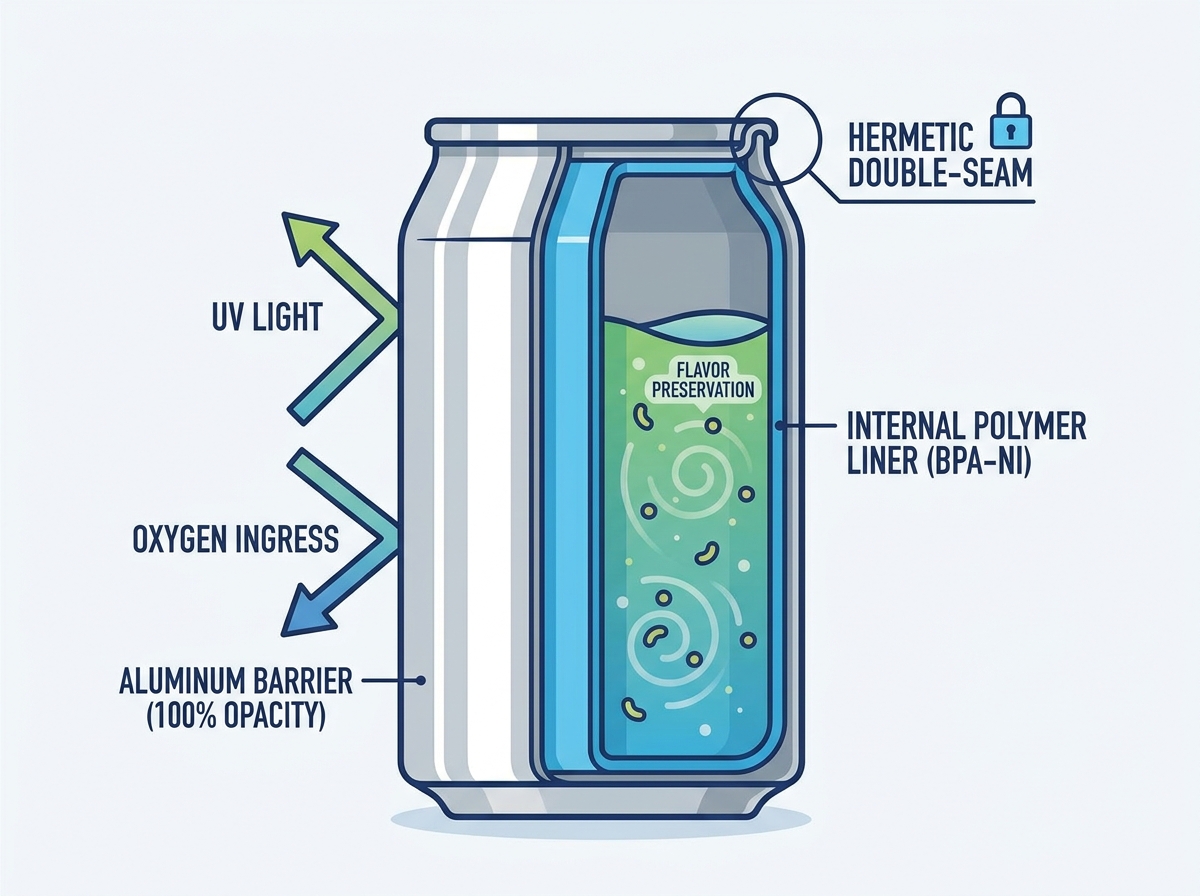
Aluminum operates as a solid metal wall. Its dense atomic structure completely blocks the entire light spectrum. Amber glass only filters out a portion of UV light. Green and clear glass offer almost zero protection against lightstrike. Because light cannot pass through aluminum, photo-oxidation simply cannot occur. This absolute opacity provides extended flavor stability for highly sensitive products. Craft brewers, energy drink manufacturers, and kombucha producers rely heavily on this trait to maintain flavor integrity over long distribution cycles.
The Hermetic Double-Seam Advantage
The closure system dictates the true oxygen barrier of any container. Beverage cans utilize a mechanical closure process called double seaming. This process tightly interlocks the can body with the lid. It creates a rigid, gas-tight mechanical seal. A specialized sealing compound fills any microscopic voids inside the seam.
Contrast this with plastic screw-caps or glass crown-pry caps. Plastic closures expand and contract during temperature changes. This movement creates micro-leaks. Crown caps on glass bottles often shift during rough transit, breaking the tight seal. The double seam on aluminum packaging remains structurally locked. It guarantees a near-zero oxygen transfer rate from the day it leaves the filling line until the consumer opens it.
The Hidden Barrier: Understanding Internal Coatings and Liners
Consumers often assume their drinks touch bare metal. In reality, modern packaging relies on highly engineered internal barriers. These liners play a critical role in preserving the liquid.
Why Bare Metal is Never Exposed
Liquid must never contact the raw aluminum shell. Many beverages contain high acid levels. If acidic liquid touches bare metal, galvanic corrosion begins immediately. The acid eats into the aluminum. This reaction imparts a harsh, metallic taint to the drink. Eventually, the corrosion creates pinhole leaks in the container. Manufacturers apply microscopic layers of organic coatings to the interior walls. These epoxy, acrylic, or polyester liners separate the sensitive liquid from the reactive metal.
Formulation and Compliance
Regulatory standards and consumer safety demands continually shape liner chemistry. The industry largely shifted away from traditional epoxy liners containing Bisphenol A (BPA). Today, modern manufacturers use BPA-NI (Bisphenol A Non-Intent) liners. These advanced formulations meet strict global regulatory standards. They remain chemically inert, ensuring they do not alter the intended flavor profile while satisfying health-conscious consumers.
Beverage-Specific Matching
You cannot use a universal liner for every drink. Manufacturers must evaluate internal spray weights based on the specific chemical profile of the product. Spray weight refers to the thickness of the coating applied inside the container. Highly acidic sodas or sour beers aggressively attack coatings. They require thicker, specialized liners. Conversely, still water or mildly carbonated teas exert far less stress on the packaging. They can utilize standard liner weights. Matching the chemistry ensures the barrier holds up throughout the entire shelf life.
Extreme durability, resists high acidity and carbonation pressure.
Craft sour beers, energy drinks, colas, high-acid juices.
2.5 - 4.5
Polyester Blends
Excellent flexibility, good flavor neutrality, resists scalping.
Hard seltzers, ready-to-drink (RTD) cocktails, delicate flavors.
3.5 - 6.0
Sourcing and Scalability: Standard vs. Custom Formats
Selecting the right physical format impacts production agility and thermal processing. You must align your packaging choice with your current scale and future growth projections.
Standard Brite Formats
Many emerging brands begin with unprinted blanks. We call these brite cans. Using standard aluminum cans offers incredible agility. They require significantly lower minimum order quantities (MOQs). Brands pair these blank shells with shrink sleeves or pressure-sensitive labels. This approach works perfectly for pilot runs, seasonal releases, or testing new markets. It allows you to pivot branding quickly without holding massive inventories of printed metal.
Direct-to-Metal Printed Formats
As production scales, temporary labels become inefficient. Transitioning to printed aluminum cans offers superior long-term ROI. Direct printing eliminates the cost of separate label application. It allows for substantially faster filling line speeds. Shrink sleeves can jam automated equipment or warp during moisture exposure. Furthermore, direct-printed metal maintains superior recyclability. Plastic sleeves often contaminate aluminum recycling streams if consumers fail to remove them.
Thermal Processing Impact
Your processing methods must align with the thermal tolerances of your packaging. When factories cure printed graphics onto the exterior, the heat can affect the internal liner. Similarly, many beverages undergo tunnel pasteurization to kill pathogens. The pasteurization temperatures must not exceed the thermal breakdown point of the internal coating. If you pasteurize too hot, the liner degrades. You must communicate your thermal processing plans to your packaging supplier to ensure material compatibility.
Implementation Risks and Storage Realities
Even the best materials fail under poor handling conditions. You must implement strict protocols to protect the physical integrity of your packaging.
Mechanical Damage and Denting
Aluminum dents under blunt force. You must address the risk of impact damage during transit and warehousing. Deep dents do more than harm shelf appeal. They can actually fracture the microscopic internal liner. When the liner cracks, it exposes the beverage to raw metal. This triggers localized corrosion and rapid flavor degradation. Rough pallet handling or unstable stretch wrapping drastically increases denting rates.
Best Practice: Use reinforced cardboard trays and highly tensioned stretch wrap for all pallet shipments.
Common Mistake: Stacking pallets too high in non-temperature-controlled warehouses, leading to lower-tier crushing.
Temperature Fluctuations
Metal handles physical temperature swings very well. However, extreme heat during storage creates chemical risks. Heat accelerates chemical reactions inside the liquid. If the internal liner is slightly mismatched to the beverage pH, prolonged heat exposure speeds up corrosion. You should store finished goods in climate-controlled environments whenever possible. Avoid leaving pallets in direct summer sunlight on loading docks.
Quality Control Protocols
Proper filling line operations guarantee packaging performance. You must test the physical and chemical integrity of the package continuously.
Seam Teardowns: Operators must pull sealed units off the line at regular intervals. They cut the lid apart to measure the internal seam thickness and hook overlap. This guarantees the hermetic seal remains within strict tolerances.
Enamel Rater Testing: Quality assurance teams use electrical conductivity to test internal liner integrity. They fill an empty shell with a conductive saline solution and insert an electrode. If an electrical current passes through the liquid to the metal, it indicates a microscopic scratch or gap in the liner.
Implementing these protocols ensures your beverage aluminum cans perform exactly as engineered.
Conclusion
Aluminum acts as an impermeable fortress for flavor. It entirely blocks light and halts oxygen ingress. However, this material only succeeds when you correctly specify the internal coating and maintain perfect mechanical seals. Bare metal offers protection, but the hidden polymer liners actually interact with your liquid.
Decision-makers must audit their beverage's chemical profile before placing an order. You need precise data on your liquid's pH, carbonation volumes, and sensitive flavor compounds. Use this data to shortlist appropriate liner materials and spray weights.
Your next steps should focus on validation. Request detailed manufacturer specification sheets for both the metal shell and the internal coating. Order pilot samples of unprinted blank units. Run these samples through accelerated shelf-life testing in your own facility. Finally, validate that your preferred format runs smoothly on your specific filling equipment.
FAQ
Q: Do aluminum cans contain plastic liners, and do they affect taste?
A: Yes, they feature microscopic polymer coatings to prevent the metal from altering the flavor. Modern BPA-NI liners are chemically inert and do not impart a "plastic" taste.
Q: Why do some cans suggest transferring the contents to a non-metallic container after opening?
A: Once opened, oxygen enters. If stored long-term in an open can in a fridge, the introduction of oxygen can sometimes interact with exposed metal edges at the opening, though this is primarily an aesthetic or extreme long-term storage concern rather than an immediate safety issue.
Q: How does the shelf life of beverage aluminum cans compare to glass bottles?
A: For light-sensitive and oxygen-sensitive beverages, aluminum typically offers a longer stable shelf life due to zero light penetration and lower oxygen transfer rates compared to standard bottle closures.