What Makes Aluminum Cans Suitable for Beverage Packaging?
Views: 0 Author: Site Editor Publish Time: 2026-08-03 Origin: Site
Commercial beverage packaging decisions require a delicate, high-stakes balance. Brands constantly weigh raw product integrity against strict supply chain economics and shifting environmental compliance rules. Navigating these operational factors remains essential for long-term market survival. Beverage producers desperately need a highly reliable container format. The chosen vessel must aggressively prevent oxidation and UV degradation to protect sensitive liquids. Furthermore, it must scale smoothly on high-speed filling lines without creating costly production bottlenecks or workflow disruptions.
This article provides an objective, deep-dive evaluation of why metal packaging currently dominates the global beverage sector. We thoroughly analyze the structural benefits, logistical efficiencies, and operational viability of these containers for diverse commercial applications. By examining key performance metrics, you will learn exactly why these resilient containers remain the ultimate choice for both established enterprises and rapidly growing beverage startups alike.
Key Takeaways
Absolute Barrier Protection: Aluminum provides a 100% barrier against light and oxygen, maximizing shelf life and preserving flavor profiles.
Logistical Efficiency: The high strength-to-weight ratio minimizes shipping costs and maximizes pallet density compared to glass or rigid plastics.
Infinite Recyclability: True closed-loop recycling capabilities yield the highest circular performance of all commercial beverage packaging.
Scalable Decorating: Solutions range from sleeved blanks for low-MOQ runs to fully printed aluminum cans for high-volume brand standardization.
Evaluating Product Integrity: The Engineering Baseline
Begin with the incredible 360-degree barrier. Sensitive liquids degrade quickly when exposed to environmental elements. UV light and oxygen actively destroy delicate flavor compounds. Beer, kombucha, and functional waters require strict chemical protection. If UV rays hit hop compounds, a volatile chemical reaction occurs. This creates rapid photo-oxidation. The industry commonly calls this defect skunking. Metal provides an absolute barrier. It completely blocks light and oxygen ingress. This unique structural trait guarantees long-term product stability. Your beverage tastes exactly as the brewmaster intended.
Next, consider the physics of thermal conductivity. Consumers want ice-cold drinks fast. Standard beverage aluminum cans chill significantly faster than glass or thick plastic. The metal transfers heat efficiently and rapidly. This rapid chilling capability vastly improves the end-user experience. It also boosts commercial refrigeration efficiency. Convenience stores and retailers save energy cooling these specific products. Efficient chilling reduces electricity usage across the entire retail footprint.
However, raw metal reacts poorly to certain liquids. High acidity or heavy carbonation strips raw metal surfaces. Brands must use internal liners to prevent this chemical degradation. Manufacturers spray liquid epoxy or polymer coatings inside every unit. They bake these liners to create an impenetrable shield. Today, the global industry heavily relies on BPA-NI (Non-Intent) liners. These modern coatings ensure complete chemical stability. They aggressively protect the liquid flavor profile. They also maintain the structural integrity of the container itself.
Supply Chain Logistics and Unit Economics
Shipping heavy packaging drains profit margins quickly. Weight and volume dynamics directly dictate freight expenses. Let us carefully compare typical logistics profiles. Empty glass bottles weigh significantly more than empty metal alternatives. A standard glass bottle often exceeds 180 grams. A comparable metal unit weighs roughly 15 grams. Filled units also showcase a massive weight disparity. Transporting lighter materials heavily reduces direct fuel consumption. Brands realize immediate, highly measurable reductions in outbound freight costs.
Form factor standardization drives further supply chain efficiency. Utilizing standard aluminum cans unlocks vast global co-packing networks. A classic 12oz or 355ml size fits almost any automated filling line. You completely avoid custom tooling delays. High-speed facilities easily process these standard formats daily. This ubiquity streamlines production scheduling immensely. It allows brands to shift production between different facilities effortlessly.
Transit durability presents another distinct financial advantage. Glass shatters unexpectedly during rough handling. Shattered glass causes complete inventory loss. It also creates dangerous safety hazards for warehouse staff. Metal packaging handles physical impact entirely differently. It may suffer cosmetic denting when dropped. Denting hurts visual appeal on the retail shelf. However, a dented unit rarely causes catastrophic liquid leaks. The overall inventory loss rate drops significantly during cross-country transit.
Packaging Metric
Metal Container
Glass Bottle
Empty Weight (12oz)
~15 grams
~180 grams
Pallet Density
Extremely High
Moderate to Low
Transit Breakage Risk
Cosmetic Denting
Catastrophic Shattering
Stacking Strength
Excellent
Good (but fragile)
Brand Scalability: Printed Aluminum Cans vs. Alternatives
Scaling a beverage brand requires strategic, forward-thinking decorating choices. High-volume production relies entirely on direct-to-can offset printing. This specific method operates at blinding commercial speeds. It offers the absolute lowest per-unit cost available today. Established global brands depend heavily on this operational efficiency. Offset printing applies specialized ink directly onto the curved metal surface. The result is a seamless, highly premium visual finish. It reinforces brand authority instantly.
However, Tier-1 manufacturers enforce notoriously strict minimum order quantities. They typically require MOQs ranging from one to three full truckloads. You must often commit to millions of units per specific SKU. Buying custom printed aluminum cans requires significant upfront capital investment. Forecasting errors can permanently trap vital cash in unused inventory. Small brands simply cannot survive this financial risk without proper planning.
Emerging brands urgently need flexible, low-risk bridging strategies. You can order unprinted, blank "brite" containers instead. Co-packers then apply high-quality pressure-sensitive labels. Shrink sleeves provide another incredibly popular visual alternative. A heat tunnel shrinks the printed sleeve tightly around the metal. These flexible methods support low-MOQ market test runs. You validate product-market fit before risking massive capital expenditures. Once a specific flavor succeeds, you transition smoothly to printed formats.
Assessing Circular Performance and ESG Impact
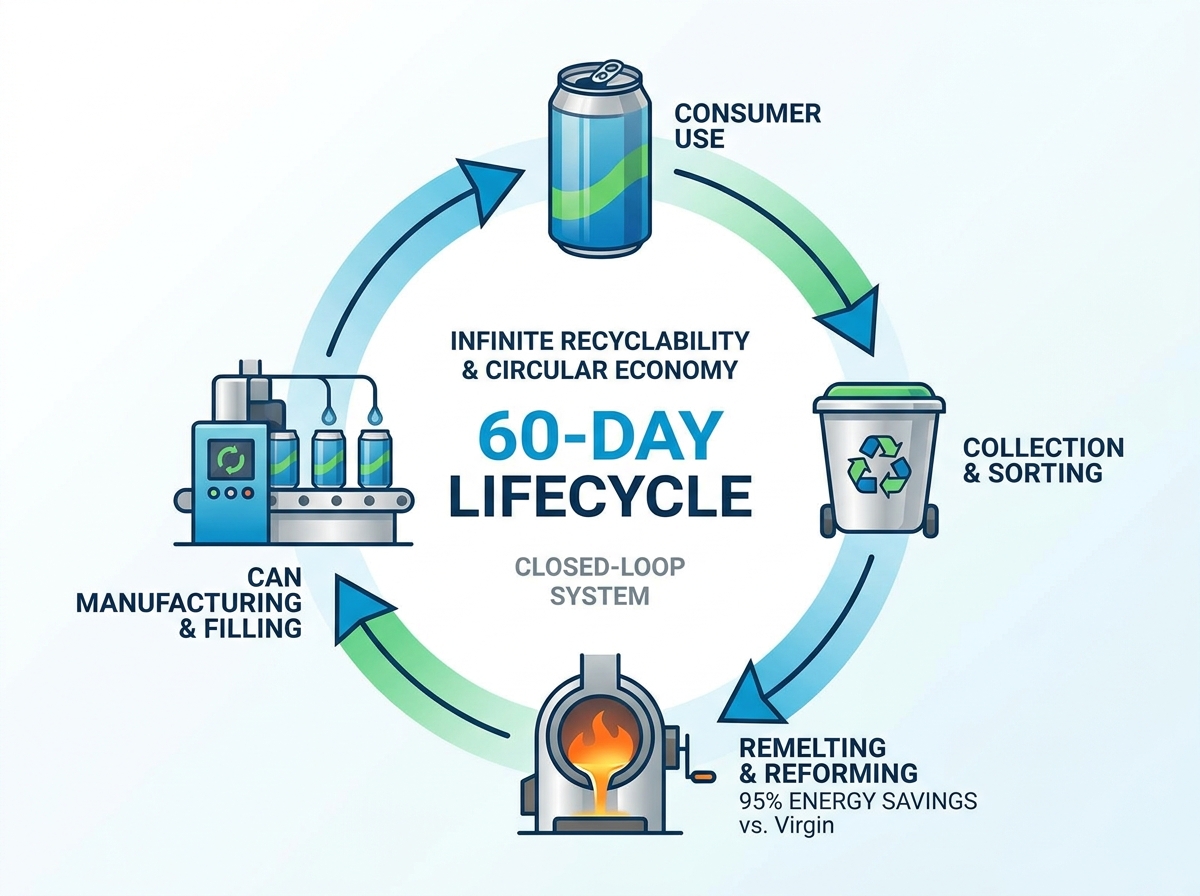
Environmental compliance now heavily dictates major packaging decisions. Metal offers unparalleled, highly documented circular performance. The true closed-loop reality of this material is truly remarkable. A recycled unit often returns to retail store shelves within 60 days. This rapid turnaround perfectly defines true commercial sustainability. Furthermore, the base material retains unusually high scrap value. This strong financial incentive subsidizes municipal recycling programs worldwide.
Let us examine the complete closed-loop lifecycle stages carefully:
Consumers deposit empty, rinsed units into local municipal recycling bins.
Recovery facilities sort and compress the collected metal into massive dense bales.
Industrial smelters melt the bales down entirely, burning off residual inks and coatings.
Rolling mills flatten the newly purified liquid metal into massive sheets.
Packaging manufacturers punch and form these rolled sheets into brand-new containers.
Carbon footprint discussions require an objective, highly balanced view. Virgin aluminum smelting relies on intensive Bauxite extraction. This initial mining process is undeniably energy-intensive and ecologically disruptive. However, utilizing Used Beverage Cans (UBCs) changes the ecological math completely. Melting recycled material uses 95% less total energy than virgin production. High recycling rates drastically mitigate those initial carbon impacts over time.
Legislative readiness is another increasingly crucial operational factor. Extended Producer Responsibility (EPR) laws are aggressively expanding globally. Governments are actively rolling out strict single-use plastic taxes. Integrating Aluminum Cans helps brands completely sidestep these looming regulatory hurdles. Transitioning to metal definitively secures long-term ESG compliance. You actively protect your growing brand from sudden, unpredictable regulatory fines.
Implementation Risks and Procurement Realities
Adopting metal packaging introduces highly specific operational risks. You cannot simply pour any novel liquid into these vessels. Rigorous corrosion and pH testing are absolutely mandatory steps. Novel functional beverages often contain aggressive, highly reactive ingredients. High-acid or high-salt liquid formulas can aggressively attack the internal liner. Brands must conduct formal 6-to-12-month shelf-life compatibility tests. Failing to test leads to rapid liner degradation and massive product spoilage.
Supply chain volatility remains a persistent, undeniable industry threat. Domestic packaging supply chains have faced severe historical constraints recently. Relying entirely on a single manufacturing supplier invites operational disaster. You must forecast production volumes highly accurately. Securing firm secondary supplier agreements is a fundamental procurement best practice. Diversified sourcing protects your fragile production schedule during regional material shortages.
Finally, you must consider the operational mechanics of physical sealing. The critical double-seam process requires extreme mechanical precision. Fillers must calibrate seaming equipment perfectly before every single run. Improper seaming rapidly creates microscopic, invisible leaks. These micro-leaks destroy carbonation levels entirely. They also invite dangerous bacterial contamination into the liquid. A bad seam inevitably triggers a highly public, total product recall.
Review the following common procurement and implementation mistakes carefully:
Skipping mandatory liner compatibility tests for new, untested flavor profiles.
Underestimating the extended lead times required for custom printed units.
Failing to calibrate seaming chucks and rolls precisely during line changeovers.
Ignoring transit climate variations when shipping unlabeled blank brite units.
Overlooking the necessity of secondary supply agreements for peak seasonal demand.
Conclusion
Metal containers consistently represent the optimal choice for modern beverage brands. They reliably deliver unmatched shelf-life protection against harsh environmental elements. They support highly scalable filling operations across global co-packing networks. They also provide highly measurable, widely respected ESG outcomes. However, decision-makers must weigh their immediate volume capabilities carefully. You must balance your budget against strict supplier MOQs. You must also budget adequate developmental time for mandatory liner compatibility testing.
Take these immediate, action-oriented next steps to advance your packaging strategy:
Request physical material and internal liner samples from multiple tier-1 and tier-2 manufacturers.
Consult your designated co-packer immediately to confirm their exact preferred tooling sizes.
Initiate rigorous structural and chemical compatibility testing for all your active beverage SKUs.
Develop a highly bridged volume forecast to plan your strategic transition from labeled blanks to printed units.
FAQ
Q: What is the minimum order quantity (MOQ) for custom printed aluminum cans?
A: Tier-1 manufacturers typically require high minimum order quantities. You can expect MOQs ranging from one to three million units. The exact number depends on the supplier and the specific container size. If you need smaller volumes, consider digital printing or utilizing packaging brokers. They offer lower thresholds but charge a higher cost per unit.
Q: Are beverage aluminum cans truly 100% infinitely recyclable?
A: Yes, they boast infinite recyclability. This is a distinct metallurgical reality. The core metal does not degrade structurally during the melting process. You can melt and reform the material endlessly without losing quality. Unlike plastics, which downcycle into lower-grade materials, this metal remains perfectly viable for new food-grade containers forever.
Q: Do standard aluminum cans contain BPA?
A: Historically, internal epoxy liners contained BPA. However, regulatory shifts and consumer demands forced an industry-wide transition. Most manufacturers now utilize BPA-NI (Non-Intent) liners. These modern coatings offer robust chemical protection without intentionally added BPA. You should always verify the specific liner specifications directly with your chosen packaging manufacturer before ordering.
Q: How does the shelf life of a beverage in an aluminum can compare to plastic?
A: Metal offers an absolute gas and light barrier. This structural advantage often yields a shelf life of 12 months or more for sensitive liquids. Conversely, PET plastic is naturally porous. It allows gradual oxygen ingress and carbonation loss over time. UV light also penetrates plastic, accelerating flavor degradation much faster than metal packaging.