What Should Buyers Check Before Ordering Aluminum Cans?
Views: 0 Author: Site Editor Publish Time: 2026-08-17 Origin: Site
Securing a reliable supply of Aluminum Cans is one of the highest-risk phases in beverage manufacturing. Brands often underestimate the complexity behind this procurement process. Ordering incompatible specs, ignoring liner requirements, or misunderstanding minimum order quantities (MOQs) inevitably results in product spoilage. It also causes filling line rejections and disrupts cash flow. You need a proactive strategy to mitigate these costly production errors.
This article provides a rigorous, vendor-neutral evaluation framework. Procurement managers and brand owners will learn how to verify technical, commercial, and operational requirements. We guide you through matching liquid profiles to can architecture. You will discover how to evaluate exterior finishing options and establish robust quality assurance protocols. By following these steps, you can confidently verify every detail before signing a supply agreement.
Key Takeaways
Verify technical compatibility first, including internal liners (e.g., BPA-NI) and correct end sizes (e.g., 200 vs. 202) for your specific liquid profile.
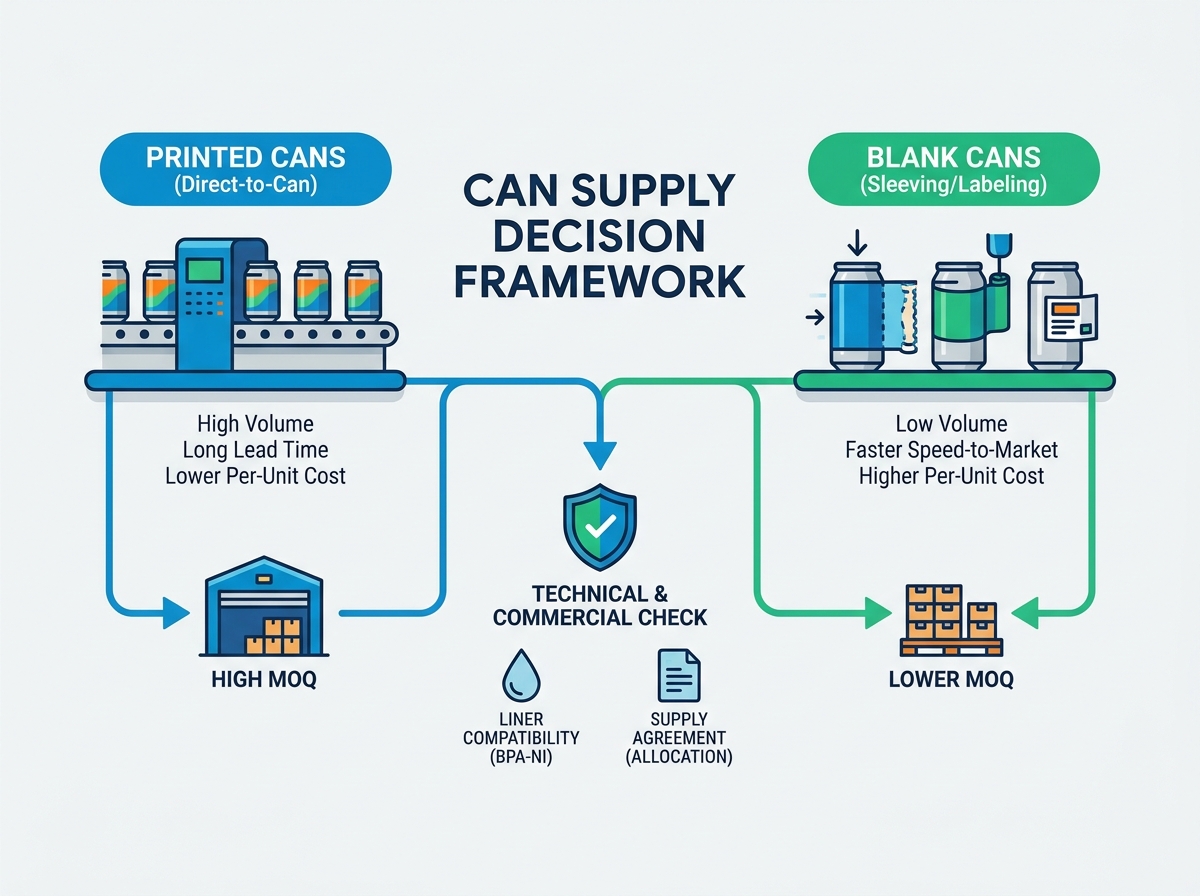
Weigh the operational trade-offs between blank cans (for sleeving) and printed aluminum cans based on accurate volume forecasting and MOQs.
Protect your supply chain by scrutinizing supply agreement terms, allocation guarantees, and lead times, rather than evaluating on per-unit cost alone.
Confirm seamer tooling and dimensional compatibility with your chosen co-packer before finalizing any order.
Technical Specifications: Matching Can Architecture to Your Liquid
You must match physical packaging dimensions to your specific product formulation. Packaging decisions dictate production capabilities and shelf presence. A mismatch here guarantees costly production delays.
Standard vs. Specialty Sizes
Buyers frequently choose between traditional profiles and sleek or slim variants. Brands often rely on standard aluminum cans like 12oz (355ml) and 16oz (473ml). These sizes dominate retail spaces. They fit universally into common retail racking systems. Co-packers universally support these standardized dimensions.
Sleek and slim variants offer premium aesthetics. However, they introduce unique operational challenges. Non-standard sizes require specialized seamer tooling. They often demand customized secondary packaging. Retailers may also struggle to fit them into standard cold vault glides. Always verify co-packer compatibility before committing to a specialty shape.
Liner Compatibility: The Most Critical Technical Decision
Beverages interact chemically with raw aluminum. You must protect the metal using specialized internal coatings. Suppliers call these coatings liners.
Brands must test their beverage against potential liners. You should measure acidity (pH), carbonation levels, and ingredient profiles. High-acid liquids require thicker or different epoxy blends. Energy drinks containing aggressive vitamins demand specialized chemical barriers.
The industry recently shifted toward BPA-NI epoxies and acrylic liners. BPA-NI stands for BPA Non-Intent. Regulatory pressures and consumer preferences drive this transition. You must ensure your supplier offers certified BPA-NI options.
Risk Factor: Never skip a formal corrosivity test. Guessing liner compatibility creates immense financial risk. Incompatible liquids will eat through the liner over time. This leads to pinhole leaks across entire pallets. Customers will taste metallic off-flavors. Your product shelf life will drastically shrink.
Can Ends and Seam Requirements
A can body requires a compatible lid, known as the end. You must pair the body diameter perfectly with the correct end size. Most modern standard bodies require 202 diameter ends. Older legacy systems used 206 ends, but 202 is now the industry standard. It saves material and reduces waste.
You must also select the opening type. Large Opening Ends (LOE) provide a smoother pour. Standard ends work well for highly carbonated sodas. Discuss these functional preferences with your supplier early in the process.
Evaluating Exterior Finishing: Printed Aluminum Cans vs. Blank Alternatives
Your decoration strategy impacts both cash flow and lead times. Brands must choose between direct printing and post-production labeling.
Printed Aluminum Cans (Direct-to-Can)
Direct printing applies ink straight onto the metal body. Manufacturers execute this process at massive speeds.
Success Criteria: This method works best for established brands. You need predictable, high-volume run rates. It suits core product lines perfectly.
Trade-offs: Direct printing requires massive minimum order quantities. Expect to order one or more truckloads per SKU. Buyers must pay upfront plate fees for every color. Lead times stretch out significantly. However, printed aluminum cans yield the lowest per-unit cost at scale. They also offer optimal recyclability without label interference.
Blank Cans for Shrink Sleeving or Pressure Sensitive Labels (PSL)
Many brands buy undecorated shells. They apply labels locally before or after filling.
Success Criteria: Blank shells remain ideal for pilot runs. They work perfectly for seasonal flavors or fragmented SKU portfolios. Startups rely heavily on this flexible approach.
Trade-offs: Post-production labels offer faster speed-to-market. They drastically lower initial volume requirements. Unfortunately, they introduce higher per-unit costs. Shrink sleeves create potential recycling compliance issues. Material recovery facilities often reject sleeved cans. You also risk sleeve wrinkling during thermal pasteurization processes.
Decision Framework
Map your brand maturity against your cash-flow realities. Avoid over-leveraging capital on initial inventory. We outlined the main differences below to help guide your choice.
Comparison of Exterior Finishing Options
Finishing Method
Ideal Use Case
MOQ Requirement
Per-Unit Cost
Recyclability
Direct-to-Can Printing
Core SKUs, High Volume
Very High (Truckloads)
Lowest at scale
Excellent
Shrink Sleeves
Seasonal, Pilot Runs
Low (By the pallet)
Moderate to High
Poor (May disrupt sorting)
Pressure Sensitive Labels
Craft brands, Small runs
Very Low
High
Moderate (Requires removal)
Quality Assurance and Structural Integrity Standards
Rigorous quality control prevents catastrophic failures on the filling line. You must demand transparency from your manufacturing partners.
Inspection Protocols
A reputable supplier routinely tests their production batches. They should willingly share their quality metrics. Request documentation for three critical tests:
Double Seam Integrity Reports: The seaming process locks the lid to the body. Improper seams allow gas to escape and bacteria to enter. Verification prevents spoilage.
Axial Load Resistance: This measures vertical crush strength. Containers must support the weight of stacked pallets. Weak walls collapse during shipping.
Enamel Rater Testing: This electrical test checks internal liner coverage. It detects microscopic scratches or missing epoxy. Perfect coverage prevents corrosion.
Handling and Palletizing Requirements
Suppliers ship empty cans in massive, tightly bound pallets. They stack them in tiers. They separate each tier using protective slip sheets. You must review these palletizing configurations. Ask about pallet heights and strapping methods. Incorrect strapping crushes the outer layers.
Risk Factor: Assess the acceptable damage tolerance per pallet. The industry typically accepts 1% to 2% damage per load. Minor dents happen during transit. However, you must establish defect remediation policies early. Warn against suppliers avoiding clear replacement terms. If a forklift damages half a pallet of beverage aluminum cans, you need guaranteed financial recourse.
Standard Quality Assurance Metrics
Test Name
What It Measures
Why It Matters
Double Seam Teardown
Lid-to-body seal thickness and overlap
Prevents leaks, maintains carbonation, and ensures sterility.
Axial Load Test
Vertical crush strength of empty container
Ensures pallets will not collapse when stacked in warehouses.
Enamel Rater Test
Electrical conductivity inside the container
Confirms complete liner coverage to prevent liquid-metal reactions.
Navigating Supply Agreements and Commercial Terms
Purchasing packaging involves more than just a price quote. You are building a long-term supply chain. A poorly structured contract exposes you to material shortages.
Defining Minimum Order Quantities (MOQs)
Manufacturers enforce strict minimums. Realistic MOQ tiers vary drastically. Single pallets of blank shells are easily accessible through regional brokers. Millions of units are required for custom prints directly from tier-1 manufacturers. You must forecast your actual sales volume accurately. Do not order excessive inventory simply to secure a lower unit price. Stale inventory ties up critical working capital.
Lead Times and Warehousing
Evaluate supplier lead times beyond the initial delivery. You need reliable recurring replenishment. First orders take longer due to plate creation and proofing. Replenishment orders should arrive much faster.
Frame the operational implications of warehousing. Empty packaging consumes immense physical space. You must decide between self-warehousing empty inventory or utilizing just-in-time (JIT) supplier delivery. JIT delivery reduces warehouse fees. However, it requires a highly dependable manufacturing partner. Late JIT deliveries will completely halt your filling operation.
Contractual Safeguards
Pay close attention to specific legal clauses. Highlight the importance of "allocation" terms in any supply agreement. Allocation guarantees your volume during industry-wide shortages. Market disruptions happen frequently. Seasonal demand spikes routinely strain factory capacities. Without strict allocation terms, tier-1 suppliers might prioritize larger legacy brands. Your agreement must legally reserve your requested capacity.
Co-Packer and Filling Line Alignment
Your co-packer actually fills and seals the product. Your packaging choices must seamlessly align with their specific equipment.
Seamer Tooling Verification
Frame the absolute risk of buying incompatible materials. Buyers often purchase bodies their co-packer cannot physically seal. You must confirm equipment calibration. The co-packer’s chucks and rolls perform the sealing process. These parts are calibrated for exact diameters and specific end profiles. If you buy a 200 end but the co-packer runs 202 tooling, production stops. Changing tooling costs thousands of dollars and delays production by days.
Pasteurization and Processing Constraints
Your selected wall thickness must withstand the specific filling environment. Different processing methods apply different thermal and physical stresses.
Tunnel pasteurization applies high heat over long durations. Hot fill methods expose the metal to immediate temperature shocks. Liquid nitrogen dosing stabilizes still liquids by creating immense internal pressure. Each method requires specific pressure ratings. Ensure your chosen container profile safely tolerates your co-packer's exact processing environment.
Shortlisting Next Steps
We recommend a strict technical validation process. Generate a formal specification sheet (spec sheet) directly from the manufacturer. Send this technical document to your co-packing partner immediately. Require written sign-off from the co-packer's plant manager. They must formally approve the dimensions, liner, and pressure ratings. Never issue the Purchase Order until you secure this written validation.
Conclusion
Ordering aluminum packaging remains a highly technical procurement process. You should never treat it as a simple commodity purchase. Minor technical oversights cause massive downstream failures.
Your success requires perfect alignment between three elements. You must align the liquid profile, the co-packer's equipment, and the supplier's commercial terms. Ignoring any single pillar threatens your entire production run. Careful planning mitigates these risks effectively.
Takeaway 1: Always test liquid compatibility against specific internal liners.
Takeaway 2: Match your decoration strategy to your realistic cash flow and volume.
Takeaway 3: Secure written specification approval from your co-packer prior to ordering.
Start your procurement process proactively. Advise your buyers to request technical data sheets immediately. Order physical samples for seamer testing at your chosen facility. Consider initiating a consultation with a packaging specialist to map out an initial supply agreement safely.
FAQ
Q: What is the standard MOQ for custom printed aluminum cans?
A: Most tier-1 manufacturers require a minimum of one truckload per SKU for direct printing. This typically equates to roughly 150,000 to 200,000 units depending on the specific size. Some specialized brokers or digital printing facilities offer lower thresholds, occasionally starting around 50,000 units, but they generally charge a significant premium per unit.
Q: How long is the shelf life of an empty, unused aluminum can?
A: Empty packaging does not last forever. The internal liner slowly degrades over time due to oxygen exposure and temperature fluctuations. Manufacturers typically guarantee empty shells for a maximum of 6 to 12 months before filling. You must store them in climate-controlled environments to prevent premature liner failure.
Q: Do standard aluminum cans work for both carbonated and still beverages?
A: Yes, but still beverages require special handling. Standard thin-wall bodies rely on internal pressurization to maintain structural rigidity. Carbonated drinks naturally provide this pressure. For still beverages like water or juice, co-packers must utilize liquid nitrogen dosing just before sealing. The nitrogen expands, providing internal pressure to prevent crushing.
Q: What is BPA-NI and is it required?
A: BPA-NI stands for Bisphenol-A Non-Intent. It means the manufacturer did not intentionally add BPA to the chemical makeup of the internal liner. While not universally mandated by federal law, it is a strict market necessity. Major retailers often refuse products containing traditional BPA epoxies due to consumer health concerns and localized regulations.