How to Choose the Right Custom Beer Can Size, Shape, and Capacity
Views: 0 Author: Site Editor Publish Time: 2026-09-05 Origin: Site
Selecting the right packaging is a high-stakes decision for beverage brands. It dictates retail shelf placement directly. It also impacts profit margins and shapes overall brand perception. A custom beer can is not just a simple vessel holding liquid. It acts as a critical barrier against oxygen and light degradation. Furthermore, it serves as the primary touchpoint for consumer evaluation. Choosing the wrong format often causes costly production bottlenecks. It can also alienate your target audience quickly.
This article provides a robust commercial framework to guide your packaging decisions. We will evaluate specific can dimensions, capacities, lid specifications, and decoration methods. You will learn how to align these elements seamlessly against your production capabilities. Ultimately, you can match your packaging choices directly to current market expectations and operational realities.
Key Takeaways
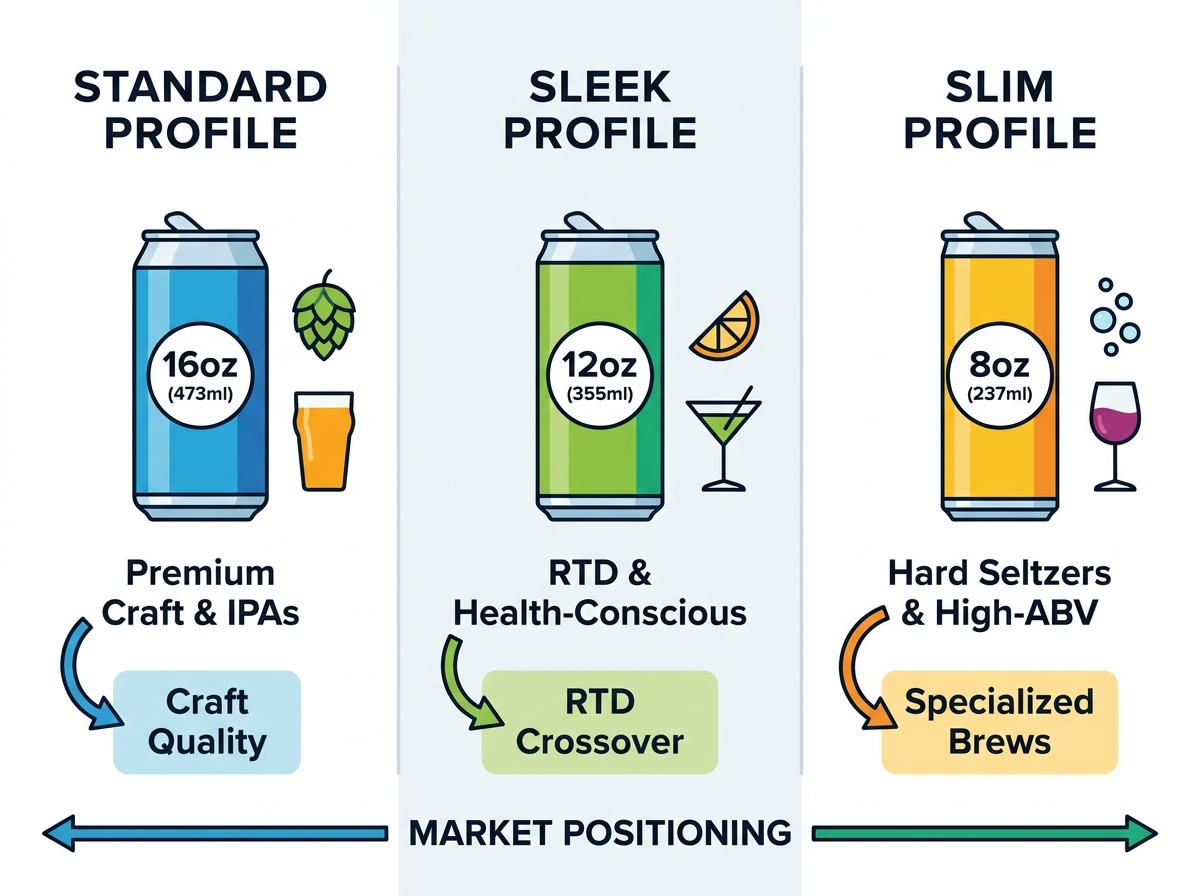
Format dictates market positioning: 16oz standard cans signal premium craft quality, while sleek and slim formats cater to health-conscious or RTD (ready-to-drink) crossover demographics.
Tooling constraints matter: Changing can shapes (e.g., standard to sleek) requires costly seamer tooling and change parts on your canning line.
Lid selection impacts shelf life: The right beer can lids must match your chosen can body diameter (e.g., 202 or 200 ends) and your seamer specifications to prevent dissolved oxygen (DO) pickup.
Customization scales with MOQ: The choice between direct printing, shrink sleeving, and pressure-sensitive labeling is entirely dependent on your Minimum Order Quantity (MOQ) tolerance and unit economics.
Evaluating Can Shapes: Standard, Sleek, and Slim Profiles
Beverage makers must choose their container shapes carefully. Each profile carries distinct mechanical requirements and marketing implications. You cannot easily swap one shape for another on a whim. The transition requires significant equipment adjustments. Let us examine the three primary profiles dominating the market today.
We see standard aluminum cans as the industry baseline. They remain broadly compatible across almost all existing co-packing lines. You will find them easy to integrate into standard labeling machines. They also fit perfectly into ubiquitous PakTech plastic carriers. Using standard profiles minimizes supply chain friction significantly. They are ideal for breweries prioritizing operational simplicity and broad distribution.
Conversely, sleek aluminum cans stand taller and narrower than standard formats. They typically hold 12oz of liquid. Their slender profile visually differentiates products on crowded retail shelves. However, this shape requires specific secondary packaging, such as specialized cartons or carriers. You must also implement distinct seamer adjustments before running them on your line.
We use slim aluminum cans for smaller capacities. They feature the smallest diameter among the three types. You often find them holding 8oz to 12oz. Consumers strongly associate this format alongside hard seltzers and wine spritzers. They also work well for high-ABV specialized brews. This profile appeals heavily to health-conscious demographics seeking portion control.
You must rely on a solid decision matrix when choosing shapes. You should assess retail shelf height restrictions carefully. Sleek containers require taller vertical clearance. You must also weigh consumer expectations regarding your specific beverage category.
Table 1: Can Shape Decision Matrix
Can Shape
Visual Profile
Primary Use Cases
Equipment Impact
Standard
Short and wide
Traditional beer, sodas
Baseline compatibility
Sleek
Tall and narrow
Premium lagers, energy drinks
Requires seamer height adjustments
Slim
Tallest and thinnest
Seltzers, high-ABV drinks
Requires different chuck and star wheels
Matching Capacity to Beverage Style and Sales Channel
Capacity selection goes beyond merely measuring liquid volume. It acts as a powerful signaling mechanism to your consumers. Different sizes dominate specific sales channels. You must match your volume to the typical consumption occasion.
The 12oz (355ml) format remains the highest-volume standard globally. It works best for session beers and everyday drinking occasions. You typically package these in 6-packs or 12-packs. This size maximizes profit margins through high-volume retail environments. Grocery stores and large liquor chains expect this standard size.
The 16oz (473ml) format represents the craft beer standard. Consumers actively expect this size for premium IPAs and robust stouts. It also dominates limited release runs. You usually sell these in 4-packs. The larger canvas provides more room for intricate label designs. It commands a higher price point per unit.
We see the 19.2oz (568ml) "Stovepipe" dominating the convenience store channel. It thrives in single-serve environments. This format is ideal for high-turnover locations. Customers grab them for immediate, single-purchase consumption. Many breweries use stovepipes to introduce their core flagship beers to new demographics.
Finally, 32oz (946ml) Crowlers serve as taproom exclusives. They offer a unique draft-to-go experience. You must install a dedicated single-can seamer behind your bar. Bartenders perform fresh, on-demand custom fills directly from the tap. This format drives immediate taproom revenue and encourages on-site engagement.
Choose 12oz for high-volume grocery distribution.
Select 16oz for premium craft releases.
Utilize 19.2oz for convenience store single-serves.
Deploy 32oz for taproom-exclusive takeaway sales.
Navigating Beer Can Lids and Seaming Specifications
Selecting the correct beer can lids is absolutely critical. A poor seal ruins your product rapidly. You must understand industry standard diameters to avoid catastrophic packaging failures. The seaming process relies on microscopic tolerances.
You must understand the dominance of the 202 end. It remains compatible across most standard and sleek profiles. Conversely, the smaller 200 end is used almost exclusively for slim formats. Mixing these up will cause immediate production stoppages. You cannot attach a 202 end onto a 200 body diameter.
Aperture styles also require careful consideration. The standard LOE (Large Opening End) provides a smooth pouring experience. It dominates the modern craft beverage market. However, you might encounter specialized configurations for unique pouring characteristics. Always verify consumer preference before diverging from the LOE standard.
Technical implementation demands rigorous oversight. You must verify your seamer's chuck and roll profiles frequently. Using mismatched components results in micro-leaks. These tiny breaches lead to rapid oxidation and product spoilage. You will lose entire batches if your seam specs drift out of tolerance.
Identify your can body diameter (standard, sleek, or slim).
Select the matching lid diameter (202 or 200 ends).
Confirm the aperture style (LOE is recommended).
Calibrate your seamer chuck and rolls precisely.
Perform regular tear-down tests during production runs.
Sustainability and sourcing play a growing role in component selection. Consider implementing lightweighted ends like the CDL or SuperEnd. These designs reduce overall aluminum usage significantly. However, they may require highly specific seamer calibrations. You must consult your equipment manufacturer before switching to lightweighted ends.
Custom Beer Can Decoration and MOQ Thresholds
Decoration methods define your brand's visual identity on the shelf. However, your production volume dictates your available choices. You must align your aesthetic desires against your Minimum Order Quantity (MOQ) tolerance. Ignoring unit economics here will drain your operational budget.
Pressure-Sensitive Labels (PSL) applied to blank silver containers offer the lowest MOQ. They provide high flexibility for small batch sizes. You can change designs easily between small runs. However, you require specific application equipment. Your labeling machinery must handle condensation issues effectively if you are filling cold liquids.
Shrink sleeves occupy the medium MOQ tier. They offer 360-degree design real estate. You can utilize premium finishes like matte textures or spot gloss. Unfortunately, shrink sleeves can cause aluminum recycling challenges. Many local municipal recycling facilities struggle to separate the plastic sleeve from the aluminum body.
Printed containers (Direct-to-Can) require the highest MOQ. Historically, suppliers demanded full truckload volumes for this method. Digital printing technology is slowly lowering this barrier. Direct printing offers the lowest per-unit cost at large scale. It also ensures 100% recyclability without municipal sorting issues.
You must chart your cost-to-volume ratio carefully. Find the breakeven point where upgrading from blank-and-label methods to direct-printed containers makes financial sense. For many craft producers, this transition happens when a single SKU reaches consistent monthly volumes.
Table 2: Decoration Method Summary Chart
Decoration Method
MOQ Level
Flexibility
Recyclability Impact
Pressure-Sensitive Labels
Low
High (easy to swap)
Moderate (labels must burn off)
Shrink Sleeves
Medium
Moderate
High risk (sorting facility issues)
Direct-to-Can Printing
High (Truckloads)
Low (locked in)
Zero impact (100% recyclable)
Implementation Risks and Supply Chain Logistics
Transitioning between different packaging formats introduces significant operational risks. You cannot treat supply chain logistics as an afterthought. Equipment compatibility and warehousing constraints dictate your actual speed to market.
Canning line compatibility is your first major hurdle. You must document the exact cost of change parts. Transitioning from standard profiles to sleek or slim formats is rarely simple. It requires a different star wheel, a new seamer chuck, and adjusted conveyor guides. These parts are expensive and require substantial downtime to install.
Secondary packaging presents another common trap. You must source the correct 4-pack or 6-pack rings. Standard PakTech carriers will not fit sleek or slim diameters securely. Cardboard cartons also require precise internal dimensions. Sourcing incompatible secondary packaging leads to loose products and retail damage.
Lead times and warehousing demand strict attention. Empty containers consume massive amounts of physical space. They ship on large pallets secured by dunnage. You must factor in this massive footprint when storing inventory. Furthermore, lead times fluctuate wildly between standard profiles and custom shapes. You might wait several additional months for specialized slim formats.
Here are common warehousing mistakes to avoid:
Underestimating the ceiling height required for multi-pallet stacking.
Failing to account for the physical footprint of dunnage and top frames.
Ordering custom sizes without securing a long-term supply contract.
Ignoring the longer lead times associated with specialized printed inventory.
Conclusion
Choosing the correct packaging format dictates your ultimate market success. You must align your container shape directly with your target demographic. Match your capacity carefully to the intended sales channel. Furthermore, ensure absolute compatibility with your existing canning equipment to avoid catastrophic production delays.
Your next steps require deliberate action. Audit your current seamer capabilities immediately. Calculate your realistic monthly sales volume to determine the most viable decoration method. Finally, request detailed technical specification sheets from potential suppliers before placing any large orders. Proper planning ensures your product looks great and remains fresh on the shelf.
FAQ
Q: Can I run standard and sleek aluminum cans on the same canning line?
A: Yes, but not simultaneously. You must purchase specific change parts for your equipment. This transition requires swapping the star wheel, adjusting conveyor guides, and changing the seamer chuck. You must also account for several hours of mechanical downtime during each changeover.
Q: What is the standard lid size for a 16oz craft beer can?
A: The industry standard for a 16oz container is the 202 end. It usually features a Large Opening End (LOE) profile. This diameter fits securely on both standard 12oz and 16oz bodies, ensuring a proper hermetic seal when seamed correctly.
Q: How do minimum order quantities (MOQs) differ between blank and custom printed cans?
A: Blank silver containers require very low MOQs. You can often order just a few pallets for label applications. Conversely, traditional direct-printed options require massive commitments. You usually need to order full truckloads per design, though digital printing is slowly lowering these thresholds.
Q: Are slim and sleek cans the same thing?
A: No, they are entirely different formats. Sleek profiles hold 12oz but are taller and narrower than standard types. Slim profiles feature an even smaller diameter. They typically hold between 8oz and 12oz and require different lid sizes (like the 200 end).