How Are Beverage Cans Designed for High Speed Filling?
Views: 0 Author: Site Editor Publish Time: 2026-08-24 Origin: Site
At speeds exceeding 1,000 cans per minute (CPM), the margin for error in beverage packaging approaches zero. Modern manufacturing demands absolute precision to prevent catastrophic machinery jams. Every single millisecond counts on an active production line. High-speed filling fundamentally relies on the specific, standardized geometry of the empty containers. It goes far beyond the sheer speed of your automated machinery. Even microscopic structural deviations lead directly to frustrating line stoppages and significant product waste. For production managers and brand owners evaluating new machinery, understanding these structural tolerances proves absolutely critical. You will learn exactly how modern container engineering prevents destructive line jams and minimizes liquid loss. We will explore key structural design parameters, ranging from flange widths to exact neck profiles. Armed with this knowledge, you can confidently scale your operations, avoid costly downtime, and ultimately maximize your capital expenditure returns.
Key Takeaways
The structural geometry of beverage cans (flange width, neck profile, dome base) dictates maximum filling speeds and seamer compatibility.
Transitioning between standard, sleek, and slim can formats requires specific changeover capabilities in rotary and inline filling equipment.
Internal coatings and the structural integrity of food grade aluminum cans are primary compliance factors when evaluating high-speed pressure limits.
Strategic line design for private label beverage cans demands equipment that balances high CPM output with rapid SKU changeover flexibility.
The Physics of High-Speed Filling: Framing the Bottleneck
High-speed operations fail rapidly when container variability causes micro-stoppages. We often see facilities struggle because they overlook the physical demands placed on empty containers. A mere 1% failure rate at 1,000 CPM results in tremendous yield loss over a standard shift. You lose 10 units every minute. Over an eight-hour run, this totals nearly 5,000 wasted units. This waste damages equipment and erodes daily profit margins. Using high-quality Beverage Cans mitigates these expensive, compounding operational delays.
Centrifugal force fundamentally alters liquid dynamics inside rotary fillers. These machines spin containers at incredibly high velocities. Liquid displacement naturally occurs as the machinery accelerates. Centrifugal forces push the beverage outward against the interior walls. Open-top designs must counteract this aggressive sloshing effect. A properly engineered opening prevents splashing before the lid application phase. Preventing splashes keeps the seaming area dry and hygienic. It also severely limits unwanted oxygen pickup. Excess oxygen ruins product flavor and significantly shortens shelf life.
Rapid pressurization introduces another massive physical hurdle. Filling valves dose liquid nitrogen or force CO2 into the container milliseconds before sealing. This purging process displaces ambient air and creates internal rigidity. We require containers built to withstand this sudden internal pressure spike. Weak structures deform instantly under these extreme gas injections. A deformed body jams the star wheels or misaligns under the seaming chuck. The structure must hold its shape perfectly during this violent transfer phase.
Anatomical Evaluation: Features to Operational Outcomes
Understanding the exact anatomy of your containers reveals why certain lines run flawlessly. Every structural curve serves a precise mechanical purpose. Operators must evaluate these features to predict machinery compatibility.
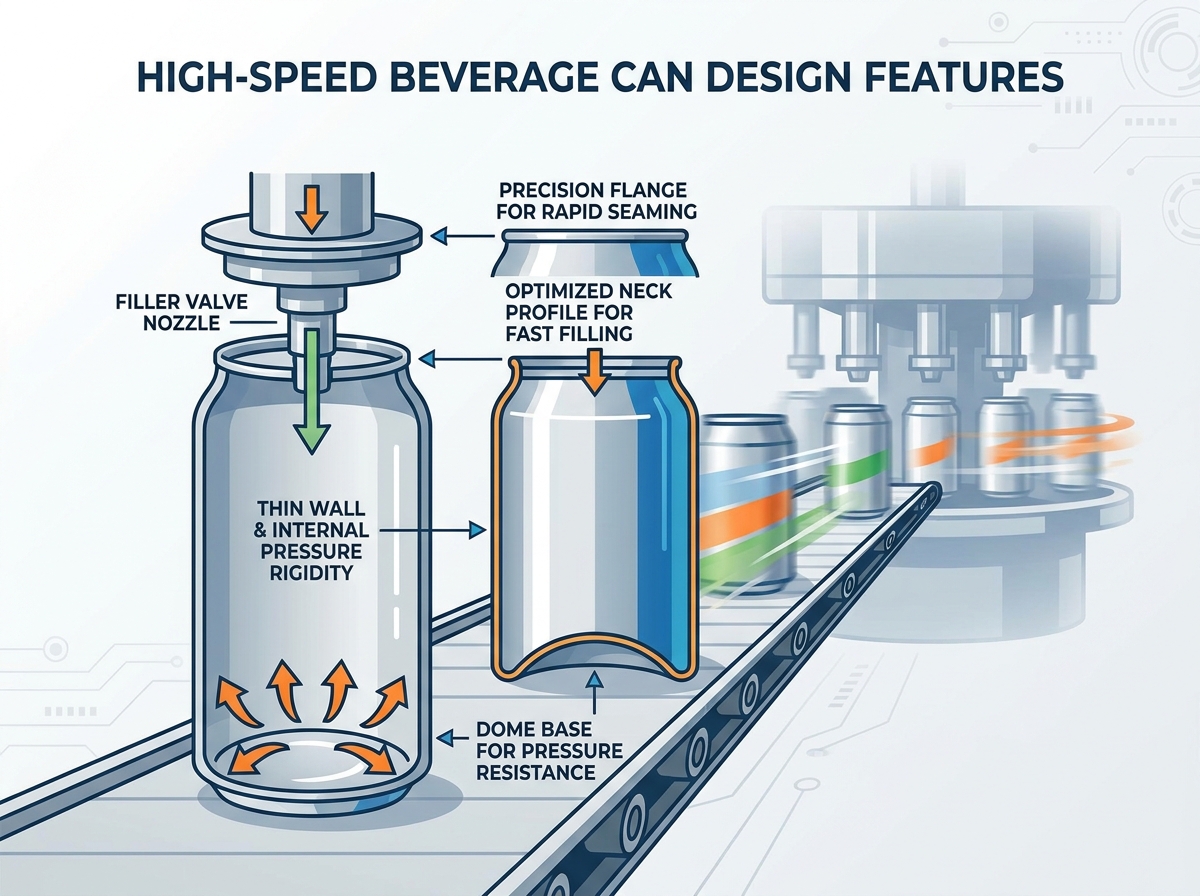
The flange acts as the critical engagement point for seaming readiness. This flared upper lip interacts directly against the seaming chuck and tooling rolls. The angle and width of this lip must remain microscopically consistent. Rollers fold this metal over the lid margin in fractions of a second. They create a hermetic double seam capable of holding high carbonation. If the flange runs too short, the seam fails to overlap properly. If it runs too wide, you risk metal wrinkling and dangerous micro-leaks.
Neck profiles dictate filler valve penetration depth and overall cycle speed. Industry standards classify these neck tapers primarily into 200, 202, and 206 end sizes. Tapering the top reduces the diameter of the required aluminum lid. This precise reduction saves millions in long-term material costs. However, a narrower neck requires modified filler valves. The valve must penetrate deeply without restricting rapid liquid flow. A 200-profile opening restricts flow rates more than a wider 202 profile. You must tune your machinery speeds to match this specific geometric bottleneck.
The base dome provides crucial inversion resistance. Manufacturers engineer this concave bottom specifically to absorb intense internal pressure. Carbonated beverages and tunnel pasteurization processes expand internal gases aggressively. The dome flexes slightly to accommodate this expansion. It prevents the bottom from buckling outward during high-speed transit. A flattened or buckled bottom causes the container to fall over on the conveyor. Downed containers instantly trigger sensor faults and halt the entire production line.
Wall thickness variances represent a masterclass in modern metallurgy. Advanced ironing processes create ultra-thin side walls. These fragile walls actually rely entirely on internal product pressure for their final rigidity. Once pressurized, they act like solid structural columns. They can suddenly withstand hundreds of pounds of downward force from the seaming chuck. Without this internal gas pressure, the seamer would instantly crush the thin aluminum walls.
Structural Feature Operational Matrix
Can Feature
Primary Function
High-Speed Filling Impact
Flange Width
Lid engagement
Dictates double seam integrity and leak prevention.
Neck Profile
Lid size reduction
Alters filler valve penetration and flow rate limitations.
Base Dome
Pressure absorption
Prevents bottom buckling during hot pasteurization.
Side Wall
Material efficiency
Requires internal pressurization to survive chuck downward force.
Matching Beverage Packaging Cans to Filling Machinery
Selecting the right equipment ensures your containers move seamlessly from depalletization to final packaging. Sourcing high-quality beverage packaging cans only solves half the equation. You must match them directly to compatible machine architectures.
We generally divide filling solutions into two distinct machine categories:
Rotary Fillers: These dominate continuous high-speed runs. They handle standard 12oz or 330ml formats effortlessly. Rotary systems rely heavily on the base stability of the container. The continuous circular motion demands absolute container uniformity.
Inline Fillers: These fit better inside smaller footprints. Craft operations prefer them for lower volume outputs. They utilize linear conveyor handling. They require different guide rails to prevent grouping or spacing errors.
Changeover dynamics dictate your actual production flexibility. Evaluating downtime remains crucial when switching between standard and sleek diameters. You must swap out star wheels, guide rails, and seaming chucks. Poorly designed changeover mechanisms consume hours of valuable production time. Modern smart-fillers utilize toolless quick-change parts. They allow operators to transition from a 330ml standard to a 250ml sleek format in under thirty minutes. Rapid changeovers keep your overall equipment effectiveness high.
Handling empty units during depalletization poses unique structural challenges. Empty units weigh almost nothing and contain zero internal pressure. Air conveyors must move them gently across the facility ceiling. Excessive air pressure causes them to collide and dent. Conveyor rails must cradle the ultra-thin side walls smoothly. Any scuffing or microscopic denting prior to the filler weakens the structural integrity. Weakened walls collapse instantly under the seamer's heavy downward pressure.
Material Integrity & Compliance: Food Grade Aluminum Cans
Material integrity determines safety, compliance, and shelf stability. You cannot scale a brand successfully without verifying chemical safety standards. Utilizing verified food grade aluminum cans protects both the consumer and the manufacturer.
Coating and compliance standards require rigorous auditing. Raw aluminum reacts terribly to acidic liquids. High-ABV products and low-pH juices will rapidly corrode unprotected metal. Manufacturers apply internal epoxy liners to separate the liquid from the raw alloy. You must verify FDA and EFSA compliance for these liners. Modern facilities increasingly demand BPA-NI (BPA Non-Intent) internal coatings. These next-generation liners prevent chemical leaching while maintaining robust corrosion resistance. They ensure your product tastes exactly as intended months after packaging.
Thermal and pressure tolerances dictate your processing options. Standard alloys feature specific failure thresholds. Tunnel pasteurization subjects the sealed unit to intense heat baths. Hot fill applications transfer thermal energy directly into the metal. The internal liquid expands rapidly, drastically spiking internal pressure. Cold fill applications avoid heat stress but often utilize intense liquid nitrogen dosing instead. The metal alloy must handle these rapid thermal shocks without fracturing or compromising the double seam.
Quality control integrations keep high-speed lines honest. You must inspect every single unit without slowing down the filling mechanism. Modern lines utilize inline x-ray scanners. These scanners detect foreign debris inside the liquid instantly. Fill-level inspection systems use gamma rays or high-frequency optics. They automatically reject under-filled units into a separate bin. Acoustic seam testing taps the lid and measures the sound frequency. A dull tone indicates a faulty double seam. These automated checks ensure compliance without sacrificing CPM output.
Scaling Production for Private Label Beverage Cans
Scaling a contract packaging operation requires immense strategic foresight. Flexibility acts as your primary competitive advantage. You need the ability to adapt to diverse client demands rapidly. Running diverse private label beverage cans demands agile, forward-thinking line architecture.
Implementation requires active risk mitigation. Locking your facility into a single-diameter filling line severely limits your agility. If market trends shift toward sleek formats, a rigid line becomes obsolete. We mitigate this risk by investing in multi-format seaming heads. Universal filler valves accommodate multiple neck profiles without major mechanical overhauls. This adaptability allows you to onboard new clients seamlessly.
Shortlisting equipment vendors involves evaluating key performance metrics. You should demand guaranteed CPM rates in writing. Vendors must provide firm changeover time warranties. Investigate their CIP (Clean-in-Place) automation capabilities. Automated cleaning cycles reduce flavor crossover risks between different client batches. Ensure the filler integrates flawlessly with upstream depalletizers and downstream pasteurizers. Disjointed equipment from different vendors causes integration nightmares.
Next-step actions focus on validation and precision.
Conduct a comprehensive pilot run using dummy liquids. This uncovers microscopic alignment issues before actual product touches the line.
Measure Overall Equipment Effectiveness (OEE) during format changeovers. Track exactly how many minutes you lose when switching from standard to slim profiles.
Audit your primary packaging suppliers extensively. Demand statistical process control charts proving their dimensional tolerances remain tight.
Taking these deliberate actions protects your capital investment. You guarantee smoother operations and higher overall output.
Conclusion
The viability of high-speed filling heavily depends on the meticulous engineering of the container itself. Machinery speed means nothing if the packaging cannot handle the physical stress. Flanges, tapered necks, and base domes must align perfectly with automated filler valves. They must withstand rapid pressurization and the violent downward force of the seaming chuck.
Decision-makers must align their packaging procurement directly with their machinery specifications prior to finalizing capital expenditures. Ensure you audit supplier tolerances strictly. Invest in multi-format changeover capabilities to future-proof your operation. Prioritize automated inline inspections to maintain compliance at high speeds. By mastering these structural dynamics, you secure reliable scalability and protect your brand's operational integrity.
FAQ
Q: What is the standard tolerance for can flange width in high-speed seaming?
A: Industry standard flange widths typically range between 2.0mm and 2.4mm, depending on the neck profile. Precise tolerance is critical. Even a 0.1mm deviation causes catastrophic seam failures at high speeds. Too short, and the seam fails to lock securely. Too long, and the metal wrinkles, causing dangerous microscopic leaks.
Q: Do sleek and slim beverage cans require different filling valves than standard cans?
A: Yes, they absolutely do. Sleek and slim designs feature narrower neck openings. You must install different centering bells on the filling machine. Spacer adjustments are also necessary to ensure the valve penetrates deeply enough without restricting liquid flow or crushing the narrower neck during the purge phase.
Q: How does internal pressure affect the can during the filling and seaming process?
A: The container relies entirely on internal pressure for its structural rigidity. Dosed liquid nitrogen or carbonated beverages pressurize the ultra-thin sidewalls. This gas expansion creates the necessary axial strength. Without it, the downward pressure of the heavy seaming chuck would instantly crush the empty aluminum shell.
Q: Can the same machine fill carbonated and still beverages?
A: Yes, but it requires specific machine architectures. Counter-pressure fillers handle carbonated drinks by equalizing pressure to prevent foaming. Still beverages often use gravity or volumetric fillers. Modern universal fillers can switch between both modes. However, you must carefully adjust purging settings and utilize liquid nitrogen dosing for still products.