Custom Printed Beer Cans: Packaging, Labels and Production Guide
Views: 0 Author: Site Editor Publish Time: 2026-10-21 Origin: Site
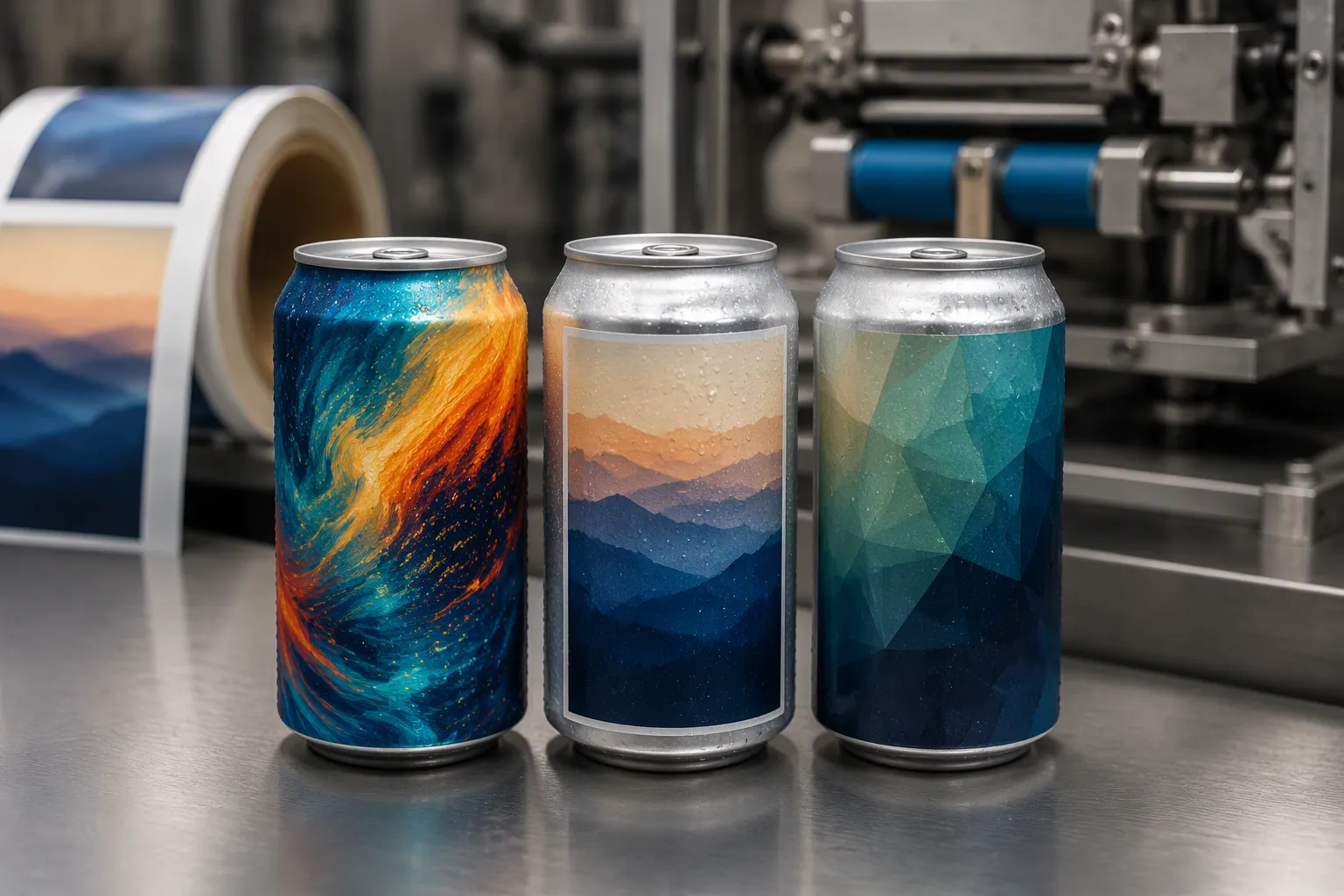
Craft beer is booming, and the shelves are crowded. Your beer deserves packaging that grabs attention and tells your story. How do you create custom beer cans that sell your brand? You have three main paths: shrink sleeves, pressure-sensitive labels, and pre-printed cans. Each option offers different benefits for your brewery. This guide walks you through design, production, costs, and TTB compliance. Suppliers like Shandong Jinzhou Health Industry Co., Ltd. provide one-stop solutions for brewers ready to stand out. Take the leap—your brand deserves it.
Key Takeaways
Pick shrink sleeves, pressure-sensitive labels, or pre-printed cans based on your budget and batch size.
Use BOPP material for beer labels because it keeps out moisture and holds your design together in ice buckets.
Digital printing is great for small batches. It is fast and has no minimum order.
Follow TTB rules for label information and get approval before you bottle and ship across state lines.
Begin with labels or sleeves for small batches, then change to pre-printed cans when your volume increases.
Shrink sleeves cover the whole can with 360-degree graphics. They work well for seasonal or limited-run beers. They are plastic and have no adhesive, so moisture does not affect them. However, they can peel off during shipping and warp at extreme temperatures. Expect to pay at least 25% more for a shrink sleeve than a pressure-sensitive label.
Pressure-sensitive labels cost less per unit and work for small batches. You put them on after filling. Moisture can stop the adhesive from sticking, so pick water-resistant materials. BOPP works well here. BOPP resists moisture. BOPP keeps labels intact in ice buckets. BOPP also handles cold temperatures without peeling. Many brewers pick BOPP for these reasons. BOPP is a strong material for beer labels. BOPP stands up to condensation. BOPP offers excellent durability. BOPP remains a top choice for craft beer packaging.
Pre-printed cans come decorated and ready to fill. They give the highest quality and a seamless look. They hold up well in wet, cold, and refrigerated environments. However, they often need minimum orders in the 100,000s.
Aspect
Shrink Sleeves
Pressure-Sensitive Labels
Pre-Printed Cans
Application
Needs sleeve applicators and heat tunnels
Applied post-fill with labeling equipment
Arrive ready to fill
Cost
At least 25% more than PS labels
Lower per-unit printing cost
Higher per-can cost
Performance
Unaffected by moisture; can peel in transit
Adhesive can fail with moisture
Holds up in wet, cold settings
Aesthetics
Full 360-degree coverage
Visible edges and seams
Seamless, label-free look
Recyclability
PVC cannot be recycled
Vinyl labels problematic
Aluminum is highly recyclable
Flexibility
Great for seasonal runs
Good for short to mid-size runs
Minimums in the 100,000s
Choosing the Right Format for Your Brewery
Your choice depends on your volume, budget, and brand goals. Putting labels on unprinted cans gives you more flexibility and saves money compared to preprinting empty cans.
Shandong Jinzhou Health Industry Co., Ltd. offers two-piece aluminum cans in sizes from 200ml to 1000ml. Popular options include 12oz (355ml), 16oz (473ml), 500ml, sleek 355ml, and slim 200ml and 250ml. These cans are lightweight, recyclable, and block light that can spoil beer. An internal lining stops direct contact with the drink and keeps the taste fresh. They meet FDA and EU REACH standards for global export.
The minimum order quantity for custom-printed cans usually starts at 100,000 units. This depends on can size and printing complexity. Smaller runs may use shrink sleeves or labels instead. Shrink sleeves typically start at 4,000 to 8,000 units. Pressure-sensitive labels start at 500 units or more.
Think about your growth plan. Custom craft beer packaging should grow with you. Start with labels or sleeves for small batches. Switch to pre-printed custom beer cans when volume makes the investment worth it. This approach keeps your craft beer packaging flexible and cost-effective at every stage.
Designing Craft Beer Can Labels
Label Size, Shape, and Material
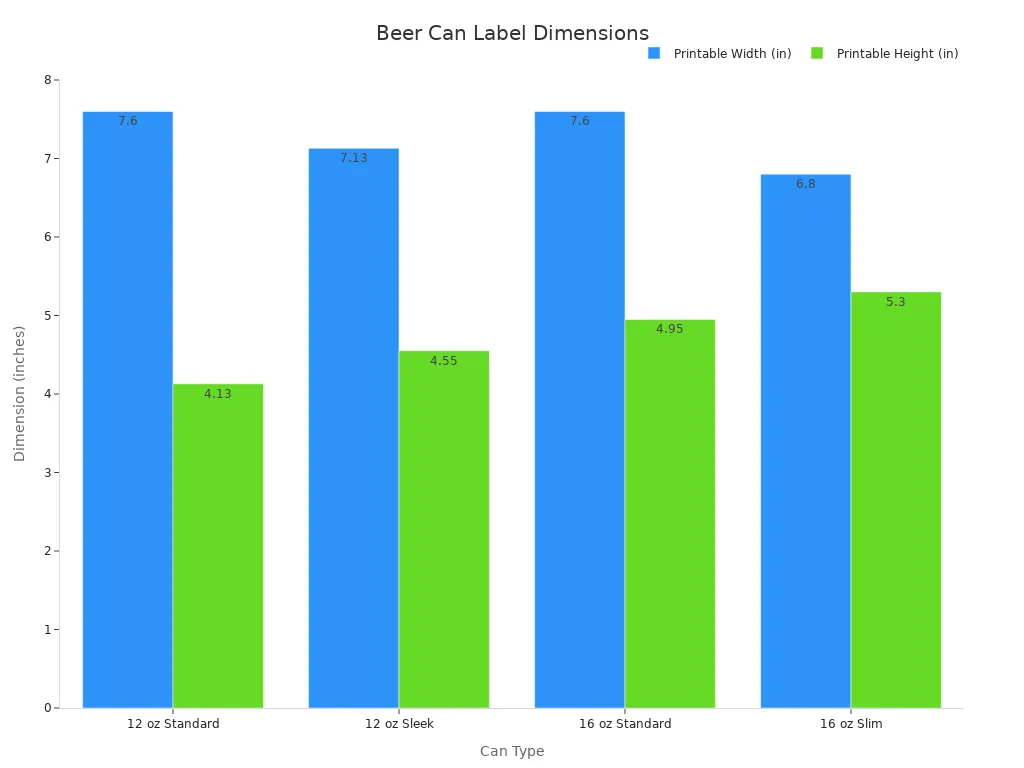
Before you design a beer can label, you need to know your can's dimensions. A 12 oz standard can has about 7.6 inches of printable width and 4.13 inches of printable height. A 12 oz sleek can gives you about 7.13 inches of width and 4.55 inches of height. A 16 oz standard can offers about 7.6 inches of width and 4.95 inches of height. These beer can label sizes affect how much artwork fits on the front.
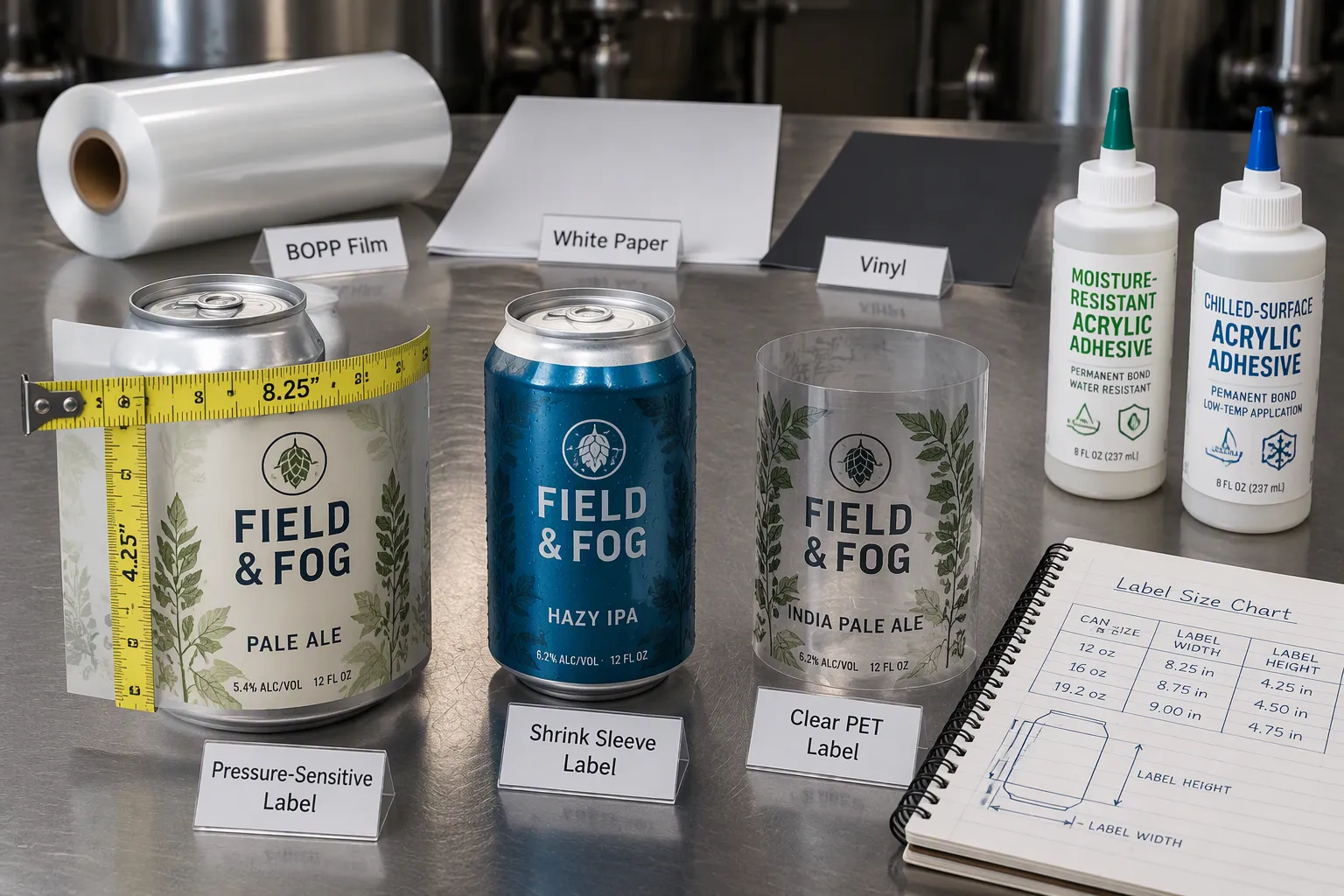
Pressure-sensitive beer can labels for a 12 oz can usually measure 3.625 to 4 inches tall and 7.5 to 8 inches wide. A 16 oz pressure-sensitive label is about 5 inches tall and 7.5 to 8 inches wide. Shrink sleeves cover the whole body, so they measure 5 to 6 inches tall on a 12 oz can and 6 to 7 inches on a 16 oz can. A standard shrink sleeve size is 8.11 by 6.14 inches (206 by 156 mm). A clear PET label often measures 3.3 by 7 inches with a 0.125-inch bleed.
The material you pick decides how your label survives the ice bucket. BOPP, or biaxially oriented polypropylene, is the best material for beer can labels. BOPP resists moisture and holds up to abrasion. BOPP also handles cold temperatures without wrinkling. White paper costs less, but paper fails in damp storage. Vinyl offers strong water resistance at a higher price. A moisture-resistant acrylic adhesive keeps labels stuck in humid conditions. A chilled-surface acrylic adhesive helps labels bond to cold, wet cans right after filling. This label material guide points most brewers toward BOPP for waterproof beer labels.
Labelling Craft Beer and Cider Cans: Material and Finish
Finish changes how shoppers see your can. Gloss reflects light and makes colors pop, which suits IPAs and fruited sours. Matte kills glare and reads as premium, which fits barrel-aged stouts and saisons. Tactile, or soft-touch matte, adds a velvety feel that picks up fingerprints but signals luxury. Paper stock takes varnish but not lamination. BOPP takes both gloss and matte laminate, so BOPP works in moisture-heavy displays. Shandong Jinzhou offers matte and tactile coatings that lift shelf presence.
"With more craft breweries selling thousands of brands at retail, the beer choices for consumers are seemingly endless... Breweries are relying on package differentiation to grab consumers' attention at the retail point of sale."
Design tips matter as much as material. Use legible fonts, because a shopper who squints has already moved on. Build a consistent look instead of chasing trends. Match the design to the beer style, and always create a mock-up before you print. Digital label printing lets you run variable artwork and short seasonal batches. Embellishments like metallic beer can labels, chrome BOPP for a clear BOPP no-label look, and holographic stock catch the eye. These choices turn custom craft beer labels and packaging into a real sales tool.
Production Guide for Custom Printed Cans
Digital vs. Flexo Printing
There are two main ways to print custom beer cans: digital and flexographic. Digital printing is great for small batches, changing data, and fast turnaround. You can print different images on each can without paying for plates. Flexo printing uses plates and saves money on large runs and high volume. The best method depends on what you need. Thermal printers are for shipping and barcode labels, not for the main can label.
Digital inkjet printing has no minimum order. You could use twelve different images and 2000 of each can in one order. There are no plate costs or dieline costs. Just send your files. Flexographic pre-printed cans need 5,000 to 25,000 or more labels per run. One industry expert says direct-to-can flexo printing is too expensive for most craft breweries. Minimums often reach one truckload or even five truckloads per SKU.
Shorter and more predictable, especially for small to mid-sized runs
Offset Printing
Weeks to months from artwork approval
Longer due to plate creation, press setup, and scheduling windows
Costs, MOQs, and Lead Times
Several things affect your custom beverage label production costs. Can size, print complexity, order quantity, and finishes all play a part. A 12oz can costs less than a 16oz can. Simple one-color designs cost less than full-color artwork. Larger orders lower your per-unit price. Matte or tactile coatings add cost but boost shelf appeal.
Shandong Jinzhou Health Industry Co., Ltd. sets its MOQ for custom-printed cans at 100,000 units. Smaller runs may use shrink sleeves or labels instead. This works for short runs of craft beer and cider. Plan your lead times carefully. Standard production takes 8 to 12 weeks. Rush orders can finish as fast as 6 weeks after artwork approval. Digital printing moves faster than offset printing. Order early to avoid delays.
Alcohol content (when derived from flavors or added non-beverage ingredients containing alcohol)
27 CFR 7.63(a)(3)
FD&C Yellow No. 5, cochineal extract or carmine, sulfites, and aspartame (if present)
27 CFR 7.63(b)
Country of origin (if imported)
27 CFR 7.69
Health warning statement
27 CFR part 16
Your label design and the materials you pick must also get TTB approval. You need label approval before bottling when your product ships out of state. Apply online through COLAs Online with a valid Permit Number. You can also mail TTB F 5100.31 in duplicate to the Alcohol Labeling and Formulation Division. TTB allows farming terms or environmental claims as extra information when they are truthful and specific.
Labels made for export markets often do not meet U.S. labeling requirements. However, in many cases, products meant for export can be brought into compliance for consumption or sale in the United States without having to completely relabel the products. If you have questions about how to modify your labels to be in compliance for the U.S. market, please reach out to the Alcohol Labeling and Formulation Division (ALFD) at 866-927-2533 or contact ALFD online.
FDA and EU REACH Compliance
Your beer can labels must also follow international rules when you export. Shandong Jinzhou's aluminum cans meet FDA and EU REACH standards for global export. This compliance covers the can itself and the internal lining that touches your beer. The lining stops the beverage from touching the aluminum directly, so the taste stays clean.
Check your label material against both TTB and destination-market rules. A beer can label approved for the U.S. may fail EU chemical restrictions. BOPP works well because BOPP resists moisture and BOPP meets food-contact requirements. Confirm your adhesive and coating choices with your supplier. Talk to a compliance specialist or check the TTB website for current regulations, because rules change.
Case Studies: Custom Craft Beer Labels and Packaging
Small Brewery Success with Shrink Sleeves
Sun King Brewery in Indianapolis shows how shrink sleeves fix real problems for small brewers. The owners, Dave Colt and Clay Robinson, worked with Century Label to make a special run for the Indiana Pacers. Each can had one shared design element, but the background was different on every can.
"We're able to work with Century Label to utilize this new printing process which was exciting for the Indiana Pacers and exciting for us to say we've got this whole new printing process that will have a standard element to the can, but the background of each and every can is going to be different."
Great River Brewery in Davenport, Iowa, was the first craft brewer to put sleeve labels on its cans. Labels for 5,000 cans come in a box about the size of one used to ship a pair of cowboy boots. You still store cans, but you can label them when you need them for any run size. This gives you flexible inventory use and fast label changes for limited runs.
Shrink sleeves give you clear benefits for your custom craft beer labels and packaging:
Run seasonal and limited-edition designs without too many cans in storage
Lower storage costs that come with pre-decorated cans
Stay flexible across multiple SKUs
Scaling Up with Pre-Printed Cans
A growing brewery will someday reach the point where pre-printed cans make financial sense. You order custom craft beer packaging in large amounts from a supplier like Shandong Jinzhou. Your per-unit costs go down, and your shelf presence gets better with matte or tactile finishes. These finishes catch light in different ways and feel premium in a shopper's hand.
The move from labels to pre-printed cans marks a real milestone. You stop paying for separate label application and start showing a seamless, professional look. Your craft beer packaging becomes a brand asset instead of a cost center. Custom craft beer labels and packaging at this stage work harder because every can carries your full design with no edges or seams.
Both paths change brand promotion at the shelf. Whether you pick shrink sleeves for flexibility or pre-printed cans for scale, your custom craft beer packaging and labels tell shoppers who you are. Great River's experience proves that craft beer label and packaging choices affect how you manage inventory and respond to market demand. Your custom craft beer labels should match your growth stage and your budget.
You now have the full plan: choose a packaging format, design your label and pick BOPP material, select digital or flexo printing, plan for the 100,000-unit minimum on custom beer cans, and meet TTB, FDA, and EU REACH rules. Custom packaging is a reachable investment for breweries of every size. Suppliers like Shandong Jinzhou Health Industry Co., Ltd. offer a one-stop solution, including aluminum end lids and plastic can holders. Start small by ordering samples or talking to a packaging specialist. Ready to get your beer into custom cans? Ask for a free quote and samples today.
FAQ
What is the minimum order for custom printed beer cans?
Shandong Jinzhou Health Industry Co., Ltd. sets its minimum order at 100,000 units for custom-printed cans. This number depends on can size and how complex the printing is. Smaller runs may use shrink sleeves or pressure-sensitive labels instead. Shrink sleeves usually start at 4,000 to 8,000 units, and pressure-sensitive labels start at 500 units or more.
Which label material works best for beer cans?
BOPP, or biaxially oriented polypropylene, is the best material for beer can labels. BOPP resists moisture and holds up to abrasion. BOPP also handles cold temperatures without wrinkling. White paper costs less, but paper fails in damp storage. Vinyl offers strong water resistance at a higher price.
What sizes of aluminum cans can I order?
Shandong Jinzhou offers two-piece aluminum cans from 200ml to 1000ml. Popular options include 12oz (355ml), 16oz (473ml), 500ml, sleek 355ml, and slim 200ml and 250ml. These cans work for beer, soft drinks, energy drinks, hard seltzer, and coffee drinks.
What information must appear on my beer can label?
The TTB requires your label to show the brand name, class and type, net contents, name and address, alcohol content when applicable, and a health warning statement. You also need country of origin for imports. Apply for label approval through COLAs Online before you bottle.
Do your cans meet international compliance standards?
Yes. Shandong Jinzhou's aluminum cans meet FDA and EU REACH standards for global export. The internal lining stops direct contact between the beverage and the aluminum, so taste stays clean. Check your label material against both TTB and destination-market rules, because a U.S.-approved label may fail EU chemical restrictions.