Custom Beer Can Production: From Artwork Approval to Mass Manufacturing
Views: 0 Author: Site Editor Publish Time: 2026-09-30 Origin: Site
Transitioning from labeled blank cans to fully printed custom cans represents a critical scaling milestone for beverage brands. It introduces strict technical and financial commitments. Many growing breweries underestimate these underlying complexities. Misalignments in the pre-press stage often lead to disastrous production results. Furthermore, choosing an unverified manufacturing partner can trigger delayed product launches. You might even face compromised beverage integrity or costly misprints. The stakes are simply too high for guesswork when expanding your brand footprint.
Successfully navigating this transition requires robust upfront preparation. You need a clear understanding of minimum order quantities (MOQs). Brands must also grasp metal printing tolerances and strict quality assurance protocols. Objective criteria for vetting manufacturing partners are vital for your long-term operational success. We will explore each phase of production to help you scale smoothly and protect your beverage quality.
Key Takeaways
Direct-printed custom aluminum cans offer the lowest per-unit cost at scale but require navigating strict MOQ thresholds (typically 50,000+ units) and longer lead times.
Artwork approval for metal requires distinct pre-press adjustments; color behaves differently on aluminum than on paper or plastic labels.
Internal coatings (liners) and double-seam integrity are non-negotiable elements of aluminum can quality control to prevent oxidation and leaks.
Selecting the right custom aluminum can manufacturer depends on their spoilage allowances, defect resolution policies, and localized warehousing capabilities.
The Business Case for Direct-Printed Beverage Can Packaging
Scaling a beverage brand forces you to evaluate different packaging decoration methods. Most brands start with pressure-sensitive labels (PSL) or shrink sleeves applied to blank brite cans. These options offer low entry barriers and minimal upfront commitments. However, as production volumes increase, these methods become financially and operationally burdensome. Direct-printed beverage can packaging eventually emerges as the most viable path forward.
Solution Categories & Thresholds
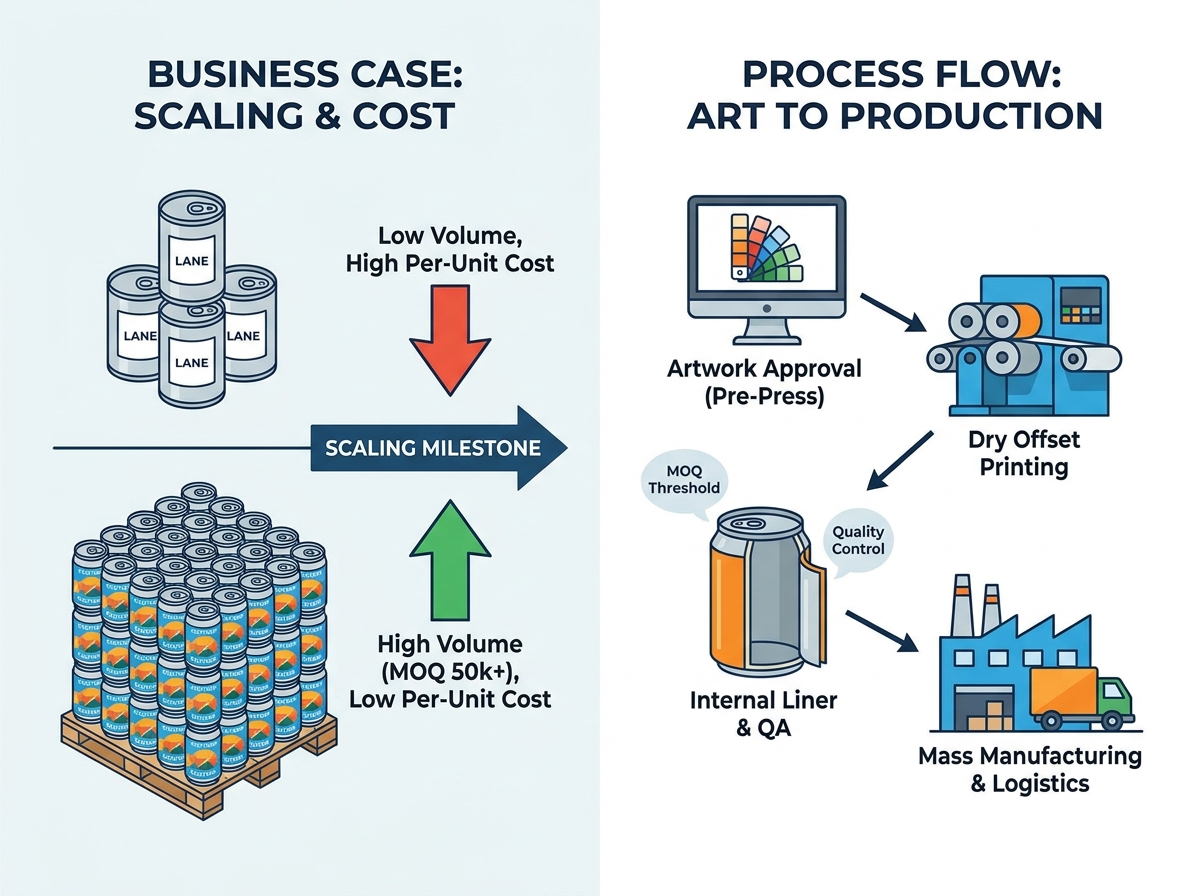
You must understand the volume tipping point for direct printing. Pressure-sensitive labels cost more per unit and require dedicated labeling machinery on your canning line. Shrink sleeves provide a full-can aesthetic but add significant material costs. Direct-to-can mass printing eliminates the secondary labeling step entirely. The economic tipping point typically occurs when you consistently package 50,000 to 100,000 units per SKU. At this volume, direct printing transitions from an expensive luxury to a necessary efficiency.
Unit Economics
Direct printing fundamentally alters your production economics. You will face higher upfront costs. Printing plates, color setup fees, and large minimum orders require substantial initial capital. However, the long-term reduction in per-unit costs is dramatic. A fully printed custom beer can arrives at your facility ready for the filler. You eliminate label inventory, labeling labor, and the downtime associated with labeling machine jams. Over a twelve-month production cycle, these operational savings compound significantly.
Sustainability & Compliance
Modern consumers and regulatory bodies demand sustainable packaging. Direct-printed aluminum excels here. It is 100% infinitely recyclable without material degradation. Conversely, shrink sleeves often cause recycling stream contamination. When consumers fail to remove the plastic sleeve, recycling sorting machines misidentify the aluminum can. Choosing direct-printed cans ensures full compliance with evolving environmental regulations. It also strengthens your brand's sustainability narrative in a competitive market.
Pre-Production Realities: Artwork, Proofing, and Tolerances
Translating digital artwork onto a cylindrical metal surface requires distinct technical adjustments. What looks perfect on a computer screen will not automatically translate to aluminum. You must navigate specific pre-press realities before mass production begins.
The Metal Substrate Challenge
Ink interacts with aluminum much differently than it does with paper. Aluminum is naturally reflective, dark, and non-porous. Standard inks are slightly translucent. If you print a yellow Pantone directly onto raw aluminum, it will look muddy and metallic. To achieve vibrant, color-accurate results, printers usually lay down a white base coat first. This base coat acts as a primer. It ensures your branding colors match your strict Pantone requirements. You must decide whether to use a full white base or leave certain areas unprinted to utilize the raw metallic aesthetic.
Technical Design Constraints
Dry offset printing is the standard method for high-speed can decoration. This method introduces specific design constraints that your graphic designer must address.
Dot Gain: Ink naturally spreads slightly when pressed onto the metal surface. This phenomenon is known as dot gain. Designers must compensate by reducing the ink density in the original file, especially in gradient areas.
Fine Text Limitations: Tiny fonts will blur during the high-speed printing process. You must adhere to the manufacturer's minimum font size guidelines to ensure regulatory information remains legible.
Trapping Requirements: Printing plates can shift slightly during production. To prevent unprinted gaps between adjacent colors, designers use trapping. This involves intentionally overlapping the edges of different color blocks.
The Approval Workflow
Rushing the approval phase leads to expensive mistakes. A structured proofing workflow mitigates these risks. You should expect this process to take several weeks.
Digital 3D Mockups: The manufacturer provides a digital rendering. You verify element placement, barcode scannability, and general layout.
Flat Metal Proofs: The printer produces a flat aluminum sheet with your artwork. This verifies color accuracy and ink behavior on the actual substrate.
Pilot Cylindrical Proofs: In some premium tiers, manufacturers create a small batch of actual printed cans. You review the final physical product before approving mass production.
The Aluminum Can Manufacturing Process Explained
The transformation from raw metal to a finished beverage container is a marvel of modern engineering. Understanding aluminum can manufacturing helps you appreciate the strict tolerances required to safely package carbonated beverages.
Forming the Canvas
The process begins with massive coils of aluminum alloy. A cupping press punches thousands of shallow cups from this sheet every minute. Next, these cups enter the drawing and ironing (D&I) process. A machine rams the cup through a series of progressively smaller rings. This action stretches and thins the metal walls to form a full-length cylinder. The cans then undergo a rigorous multi-stage washing process. This removes all forming lubricants and prepares the surface for ink adhesion. Finally, a massive oven dries the cans completely.
Applying the Custom Artwork
Once formed and cleaned, the cans move to the decorator. High-volume manufacturing utilizes dry offset printing. Multiple printing plates—one for each color—transfer ink onto a central rubber blanket. This blanket then rolls the complete image onto the spinning can in a single pass. Immediately after printing, the machine applies an overvarnish. You can choose matte, gloss, or tactile finishes. This varnish protects the ink from scratching during transit. The cans then pass through a curing oven to instantly bake and set the exterior artwork.
Structural Finishing (Necking & Flanging)
The printed can is currently a straight cylinder. It must be reshaped to accept a standard lid. The necking process gradually narrows the top opening of the can. This requires extreme precision to prevent the thin metal from collapsing. After necking, a flanger flares the very top edge outward. This creates the critical flange that your brewery's seamer will use to lock the lid in place.
Lining Application (Risk Mitigation)
The final and most crucial step is applying the internal coating. Raw aluminum reacts poorly to acidic or highly carbonated beverages. The metal can alter the flavor profile and even degrade to the point of leaking. Manufacturers spray a specialized epoxy or BPA-NI (BPA non-intent) liner inside every can. A final curing oven bakes this liner to create an impermeable barrier. This step strictly preserves the beverage's integrity and ensures consumer safety.
Standardizing Aluminum Can Quality Control
Mass production introduces the potential for microscopic defects. Premium manufacturers differentiate themselves through relentless quality assurance. Failing to verify these standards can result in catastrophic product recalls.
Evaluation Dimensions (Features-to-Outcomes)
A risky manufacturer focuses solely on printing speed and cheap pricing. A premium partner prioritizes structural integrity and consistent seamability. You must evaluate suppliers based on their internal testing protocols. Rigorous aluminum can quality control directly translates to lower spoilage rates on your canning line. It also prevents costly retail leaks and preserves your brand reputation.
Standardized Quality Testing Parameters
Testing Protocol
Primary Objective
Manufacturing Criticality
Enamel Rater Testing
Detect micro-fissures in internal liner
Prevents beverage corrosion and flavor tainting
Axial Load Testing
Measure vertical crush resistance
Ensures safe pallet stacking during freight transit
Pressure Testing
Verify burst strength
Critical for highly carbonated or pasteurized drinks
Dimensional Checks
Measure neck diameter and flange width
Guarantees flawless operation on automated seamers
Spoilage Allowances
No manufacturing process is entirely flawless. The industry standard for acceptable defect rates typically hovers between 1% and 2%. These defects might include slight color variations, minor dents, or printing misalignments. You must clarify these spoilage allowances before signing a contract. Understand exactly how the supplier handles shipments that exceed this threshold. A reliable partner will offer transparent credit or replacement policies for excessive defects.
Framework for Vetting a Custom Aluminum Can Manufacturer
Selecting the right production partner dictates your supply chain stability. You must look beyond standard pricing sheets. A robust vetting framework protects your investment and ensures scalable growth.
Capacity and MOQ Flexibility
Your actual production forecast should drive your partner selection. Legacy manufacturers often demand massive MOQs, sometimes exceeding one million units per SKU. This ties up tremendous capital and warehouse space. Agile suppliers cater to growing brands with lower MOQ thresholds, often starting around 50,000 units. Evaluate a custom aluminum can manufacturer based on their ability to scale with you. You need a partner who can handle small initial runs and massive future expansions.
Specialty Capabilities
Beverage trends evolve rapidly. Today you might need standard 12oz cans. Next year, you might launch a premium line requiring sleek cans, 16oz formats, or specialized screw-top aluminum bottles. Assess the supplier's tooling flexibility. A partner with diverse production lines prevents you from needing multiple vendors as your product portfolio expands.
Logistics & Storage Realities
Empty cans consume a massive physical footprint. Transporting and storing them requires careful logistical planning. You must determine if the manufacturer requires you to take full truckloads immediately upon production. Many premium suppliers offer staggered delivery or warehousing services. They hold your inventory and ship pallets on demand. This service is invaluable for breweries with limited on-site storage space.
Shortlisting Logic (Next Steps)
Use a systematic approach when shortlisting B2B suppliers. Follow this four-point checklist to qualify potential partners objectively:
Request Sample Kits: Inspect their print quality, tactile finishes, and structural rigidity firsthand.
Review Compliance Certifications: Demand proof of ISO, FDA, or GFSI certifications to guarantee food-safe manufacturing.
Verify Lead Times: Confirm realistic timelines for plate creation, printing, and final delivery.
Audit Claim Resolution: Ask for their official policy on handling freight damage and excessive spoilage claims.
Conclusion
Moving to mass-manufactured custom cans represents a major strategic investment for any beverage brand. Success hinges on rigorous pre-press alignment and an uncompromising approach to quality assurance. You cannot afford to treat this packaging transition casually. Carefully managing artwork tolerances, understanding liner chemistry, and verifying structural integrity will protect your product.
Your immediate next step is to consolidate your finalized artwork files into vector formats. Calculate your six-month volume projections accurately to negotiate better pricing tiers. Finally, reach out to your shortlisted manufacturers to request technical specification sheets and physical print samples. Proactive preparation guarantees a smooth launch and a superior product on the retail shelf.
FAQ
Q: What is the standard minimum order quantity (MOQ) for custom printed beer cans?
A: Traditional legacy manufacturers typically require MOQs of 200,000 to over one million cans per SKU. However, modern agile producers cater to mid-sized brands, often offering MOQs starting between 50,000 and 100,000 units, making direct printing accessible earlier in a brand's growth cycle.
Q: How long does custom aluminum can manufacturing take from artwork approval to delivery?
A: You should generally expect a realistic timeline of 6 to 12 weeks. This timeframe accounts for metal proofing, printing plate creation, scheduling time on the mass production line, and final freight transit to your facility.
Q: Are BPA-free liners standard for all custom beverage can packaging?
A: While the industry is shifting heavily toward BPA-NI (BPA non-intent) liners for consumer safety, they are not universally automatic. You must explicitly request and verify BPA-NI liner specifications in your supplier contract to guarantee compliance with modern health standards.
Q: What happens if a pallet of empty cans arrives damaged?
A: Most manufacturers operate with a 1-2% accepted spoilage allowance. If damage exceeds this due to freight mishandling or production errors, standard B2B policies require you to document the damage immediately upon receipt to file a claim for credits or replacements.