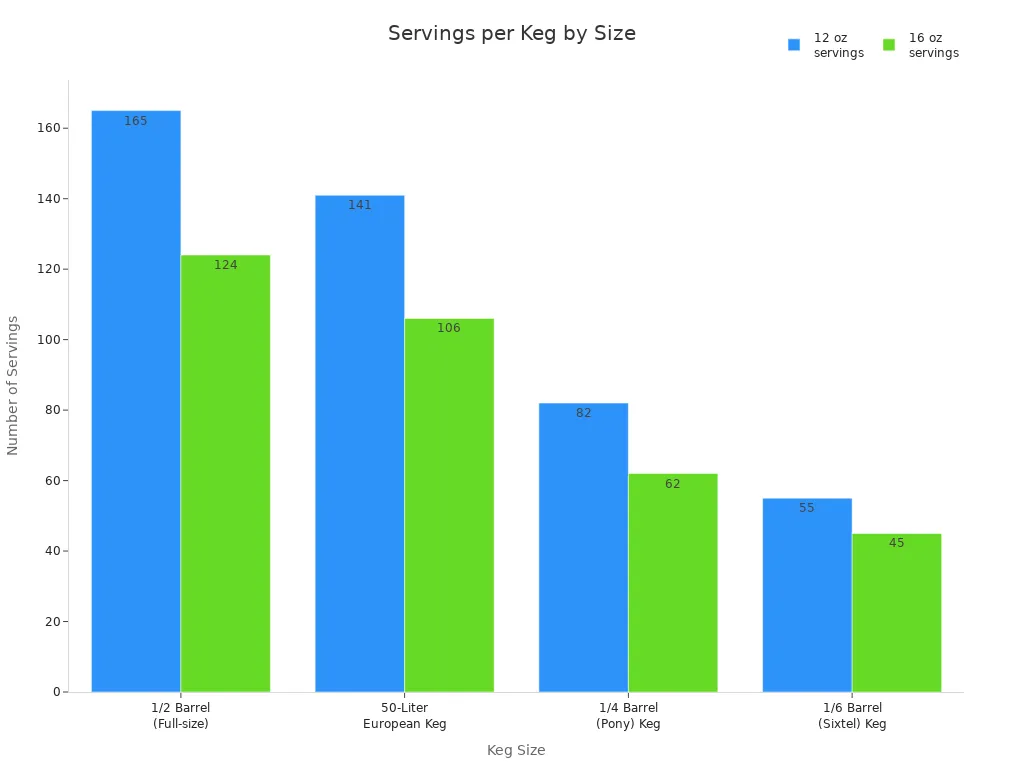
You might wonder exactly how many beers you can pour from a keg. The answer depends on both keg size and your serving size. For example, a 1/2 barrel keg holds about 165 servings if you use 12 oz cups. A 1/4 barrel gives you 82, and a 1/6 barrel pours around 56. Check the table below for more details:
Keg Size | Capacity (oz) | 12 oz Servings | 16 oz Servings | 20 oz Servings |
1/2 Barrel | 1984 | 165 | 124 | N/A |
1/4 Barrel | 992 | 82 | N/A | N/A |
1/6 Barrel | 661 | 56 | N/A | 55 |
Serving size changes the total beers you get. Always check your cup size before planning your event.
Key Takeaways
A half barrel keg holds the most beer, serving up to 165 twelve-ounce beers, making it ideal for large parties.
Quarter and sixth barrel kegs suit smaller gatherings, offering fewer servings but easier handling and storage.
Serving size affects how many beers you get; larger cups mean fewer servings per keg.
Plan for some beer loss due to foam and spillage by ordering a little extra to ensure everyone gets a full drink.
Match your keg size to your guest count, space, and tap system to avoid running out or wasting beer.
Beers Per Keg
1/2 Barrel Keg
When you choose a 1/2 barrel keg, you get the largest standard option. This keg holds 15.5 gallons, which equals 1,984 ounces. You can pour different numbers of beers depending on your cup size. Here is a simple table to help you see how many servings you get:
Serving Size | Number of Beers per 1/2 Barrel Keg |
12 oz | 165 |
16 oz | 124 |
20 oz | 99 |
If you use 12-ounce cups, you can serve up to 165 beers. With 16-ounce pints, you get about 124 beers. If you prefer 20-ounce glasses, you will pour around 99 beers. You should always check your cup size before you plan your party or event.
Tip: You may lose a few servings due to foam or spillage, so plan for a little extra if you want every guest to get a full glass.
1/4 Barrel Keg
A 1/4 barrel keg is also called a "pony keg." It holds half the volume of a 1/2 barrel keg. You get 7.75 gallons, which is 992 ounces. Here is a quick breakdown:
12 oz servings: 82 beers
16 oz servings: 62 beers
20 oz servings: 49 beers
You can use this keg for smaller gatherings. If you want to serve 12-ounce beers, you get 82 servings. With 16-ounce cups, you pour 62 beers. For 20-ounce glasses, you have enough for 49 beers.
1/6 Barrel Keg
A 1/6 barrel keg, also called a "sixtel," is the smallest of the three. It holds 5.16 gallons, which is about 661 to 672 ounces. You can see the serving breakdown in the table below:
Serving Size | Number of Beers per 1/6 Barrel Keg |
12 oz | 55 |
16 oz | 41 |
20 oz | 33 |
If you use 12-ounce bottles or cans, you get about 55 beers. With 16-ounce pints, you pour 41 beers. For 20-ounce servings, you have enough for 33 beers. This keg works well for small parties or when you want to offer a variety of beer choices.
Note: The actual number of beers may be slightly less if you have foam or waste during pouring. Always plan for a few extra servings to make sure everyone gets a drink.
Serving Sizes
![Serving Sizes]()
12 oz Servings
You often see 12 oz servings at parties and events. This size matches a standard can or bottle. Here is a quick look at how many 12 oz servings you get from each keg:
Keg Size | 12 oz Servings |
Half Barrel | 165 |
Quarter Barrel | 82 |
Sixth Barrel | 55 |
If you plan to serve a crowd, a half barrel gives you the most beers. A quarter barrel works well for smaller groups. A sixth barrel is best for small gatherings or when you want to offer more than one type of beer.
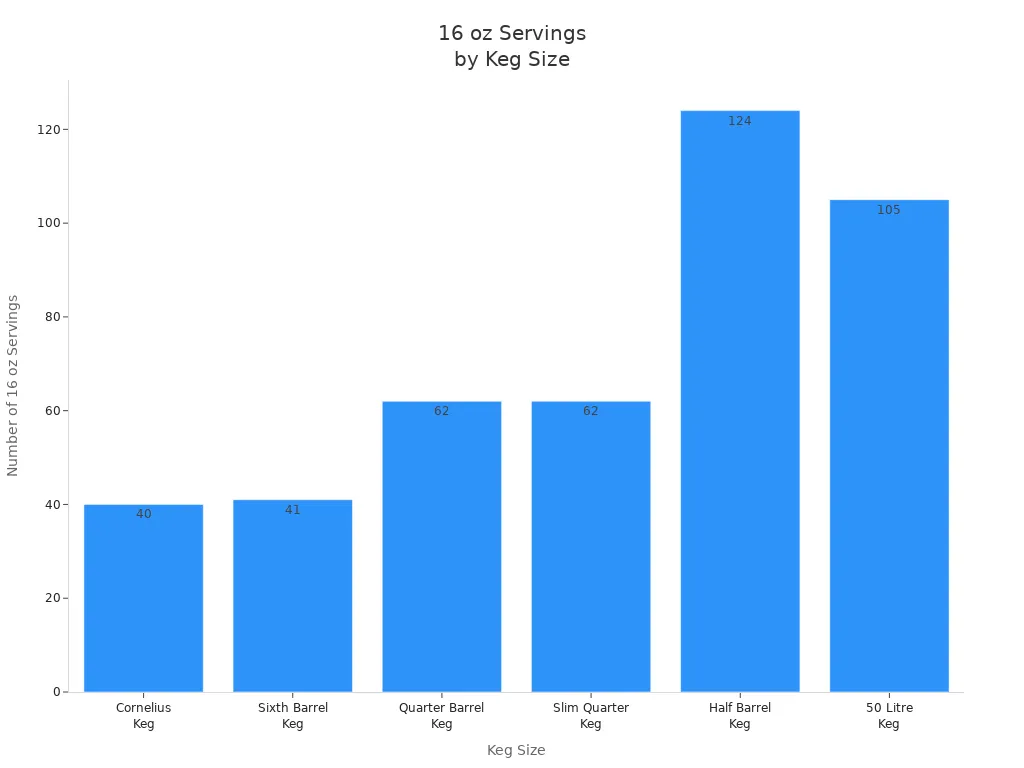
16 oz Servings
Many people enjoy 16 oz pints, especially at bars or breweries. The number of 16 oz servings you get from each keg is different from the 12 oz count. Check the table below:
Keg Size | 16 oz Servings |
Half Barrel | 124 |
Quarter Barrel | 62 |
Sixth Barrel | 41 |
![Bar chart comparing 16 oz servings for different keg sizes]()
If you use pint glasses, you will pour fewer beers from each keg. Always match your keg size to your guest list and glassware.
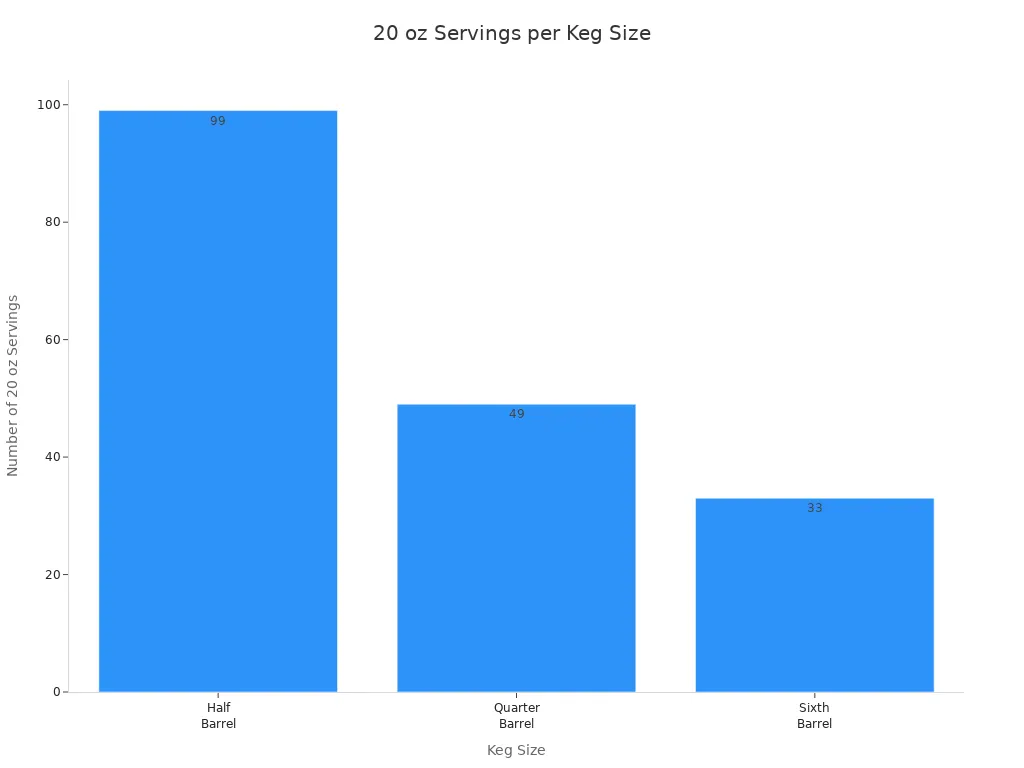
20 oz Servings
Some events use larger 20 oz glasses. This size is common for certain beer styles or special occasions. Here is how many 20 oz servings you can expect:
Keg Size | 20 oz Servings |
Half Barrel | 99 |
Quarter Barrel | 49 |
Sixth Barrel | 33 |
![Bar chart showing number of 20 oz servings for half, quarter, and sixth barrel kegs]()
You get fewer servings as the glass size increases. Make sure to plan for this if you want everyone to have enough to drink.
Tip: The actual number of servings may be less than the numbers above. Several factors can reduce your total yield:
Foam waste from temperature changes or wrong pressure settings
Spillage during pouring
Beer left in the keg or lines
Glassware size and the amount of foam (head) in each pour
Frequent keg changes, especially with smaller kegs
You can reduce waste by keeping your keg cold (34-37°F), using clean lines, and pouring carefully. These steps help you get the most beers from every keg.
Keg Comparison
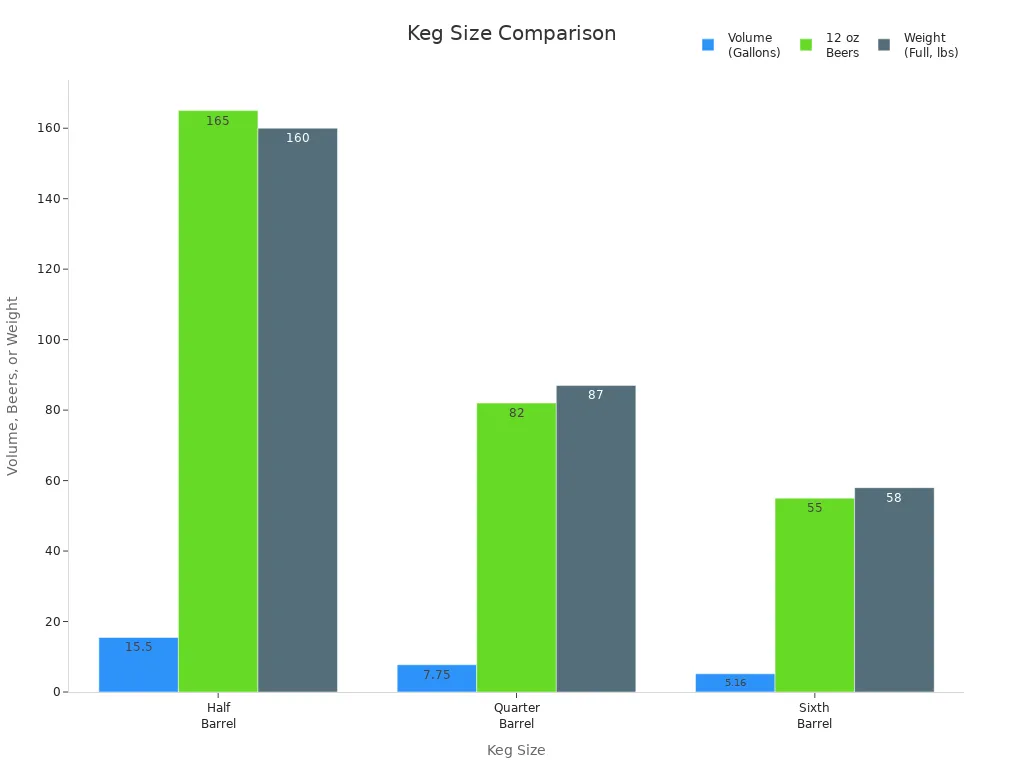
When you compare keg sizes, you want to see the differences in volume, servings, and weight. This helps you choose the right keg for your event or space. The tables below give you a clear side-by-side look at each keg size.
Volume Chart
Keg Size | Volume (Gallons) | Volume (Ounces) | 12 oz Servings | 16 oz Servings |
Half Barrel | 15.5 | 1984 | 165 | 124 |
Quarter Barrel | 7.75 | 992 | 82 | 62 |
Sixth Barrel | 5.16 | 661 | 55 | 41 |
You can see that a half barrel holds the most liquid and gives you the highest number of servings. A quarter barrel offers about half the volume of a half barrel. A sixth barrel is the smallest, making it easy to handle and store.
![Grouped bar chart comparing volume, beer count, and full weight for half, quarter, and sixth barrel kegs]()
Tip: Use this chart to match your keg size to your guest list and serving needs. A larger keg works best for big parties, while a smaller keg fits small gatherings or limited space.
Weight Chart
Keg Size | Empty Weight (lbs) | Full Weight (lbs) |
Half Barrel | 30 | 160 |
Quarter Barrel | 22 | 87 |
Sixth Barrel | 16 | 58 |
A full keg is much heavier than an empty one. You should plan for this when moving or storing your keg. A half barrel can weigh up to 160 pounds when full. A quarter barrel weighs about 87 pounds, and a sixth barrel comes in at 58 pounds when filled. Always lift with care or use a dolly to move heavy kegs.
Note: The weight of a full keg includes both the beer and the metal shell. Make sure your fridge or kegerator can support the full weight before loading it.
1/2 Barrel Keg
Dimensions
You will find that a 1/2 barrel keg is the largest standard keg available for most events. Here are the typical dimensions you can expect:
Diameter: about 16 inches
Height: slightly over 23 inches
Capacity: 15.5 gallons (58.67 liters)
Capacity in ounces: 1,984 ounces
Some manufacturers may list the diameter as 15.55 inches and the height as 23.25 inches, but most kegs fit these general measurements. This size is common in bars and restaurants across North America.
Beers by Serving Size
A 1/2 barrel keg holds enough beer for large gatherings. The number of servings depends on your glass size. Use the table below to plan your event:
Serving Size | Number of Beers |
12 oz | 165 |
16 oz | 124 |
20 oz | 99 |
If you use 12-ounce cups, you can pour up to 165 beers. Pint glasses (16 ounces) give you about 124 servings. Larger 20-ounce glasses provide 99 servings. Always check your cup size before you order your keg.
Weight
A full 1/2 barrel keg is heavy. You should know the weights before moving or storing one:
The beer inside weighs roughly 130 pounds. Always use safe lifting techniques or a dolly to move a full keg.
Best Uses
You will see 1/2 barrel kegs used most often in bars, restaurants, and breweries. These kegs work well with draft beer systems and fit in standard kegerators or walk-in coolers. If you host a large party or want to serve many guests, this keg size is ideal. Many people also use them at home for personal kegerators or man caves. You can serve a wide variety of beers without needing to buy bottles or cans. This makes the 1/2 barrel keg a popular choice for both commercial and private events.
1/4 Barrel Keg
Dimensions
You will find that a 1/4 barrel keg comes in two main styles: standard and slim. Both hold the same amount of beer, but their shapes are different. The standard version is shorter and wider, while the slim version is taller and narrower. Here are the typical measurements:
Capacity: 7.75 gallons (about 29.8 liters)
Height: around 23 inches (slim) or about 13 inches (standard)
Diameter: about 11.5 inches (slim) or 15.5 inches (standard)
Material: 304 Stainless Steel
The slim 1/4 barrel keg fits better in tight spaces, such as smaller kegerators or coolers. The standard version works well if you have more room.
Type | Capacity (gal) | Height (in) | Diameter (in) | Weight (lb, empty) |
Standard 1/4 bbl | 7.75 | 13.5 | 15.5 | 22.9 |
Slim 1/4 bbl | 7.75 | 23.2 | 11.1 | 17.4 |
Beers by Serving Size
A 1/4 barrel keg gives you a moderate amount of beer, making it a great choice for smaller gatherings. Here is how many servings you can expect:
Serving Size | Number of Beers |
12 oz | 82 |
16 oz | 62 |
20 oz | 49 |
You can serve about 82 twelve-ounce beers from one 1/4 barrel keg. If you use pint glasses, you get 62 servings. For larger 20-ounce pours, you will have enough for 49 drinks.
Tip: Always plan for a little less than the maximum number of servings. Foam and spillage can reduce your total.
Weight
You should know the weight before moving a 1/4 barrel keg. An empty keg weighs about 17 to 23 pounds, depending on the style. When full, it can weigh up to 87 pounds. Always use safe lifting methods or a dolly to avoid injury.
Best Uses
A 1/4 barrel keg works well for many types of events. You might choose this size for:
Small to medium parties, such as birthdays or graduation celebrations
Gatherings with 30 to 50 guests, where moderate beer consumption is expected
Events where you want to offer more than one type of beer
Spaces with limited room for larger kegs
You can use simple party pumps for short events. For longer gatherings, a CO2 system helps keep the beer fresh. Keeping the keg cold, between 35°F and 38°F, ensures the best taste. This keg size helps you avoid too much leftover beer, which is important if you cannot take it home due to local laws.
1/6 Barrel Keg
Dimensions
You will notice that a 1/6 barrel keg is much smaller than other keg sizes. This keg holds about 5.16 gallons, which equals roughly 661 ounces. The height usually measures around 23 inches. The diameter is close to 9 inches. You can fit this keg inside most standard refrigerators. Its compact shape makes it easy to carry and store. You do not need special equipment to move it.
Beers by Serving Size
A 1/6 barrel keg gives you enough beer for a small group. If you use 12-ounce cups, you can pour about 55 beers. Pint glasses (16 ounces) provide around 41 servings. Larger 20-ounce glasses give you 33 pours. You can see the breakdown in the table below:
Serving Size | Number of Beers |
12 oz | 55 |
16 oz | 41 |
20 oz | 33 |
You should plan for a few less than the maximum number because foam and spillage may occur. This keg size works well when you want to offer a variety of beers without buying too much.
Weight
You can lift a 1/6 barrel keg without much effort. The empty keg weighs about 16 pounds. When full, it reaches around 58 pounds. You can move it by yourself or with a friend. You do not need a dolly for most situations. The light weight makes it practical for home use and small events.
Best Uses
You will find that a 1/6 barrel keg fits many occasions. Its small size and easy handling make it perfect for personal gatherings and home parties. You can use it for events with limited space, such as apartments or small patios. Many people choose this keg for craft beer festivals, tasting events, and brewing workshops. You can try different brews without committing to large quantities. This keg supports variety and experimentation. You can store it in a standard fridge and transport it easily. It suits intimate social events where space and choice matter most.
Tip: If you want to offer several types of beer at your party, use multiple 1/6 barrel kegs. You can give your guests more options and keep the beer fresh.
Choosing a Keg
Selecting the right keg size helps you serve your guests efficiently and avoid waste. Start by estimating how many people will attend your event and how much each person might drink. For example, if you expect 50 guests and each will have about four drinks, you need around 200 servings. Use the table below to match your needs to the right keg size:
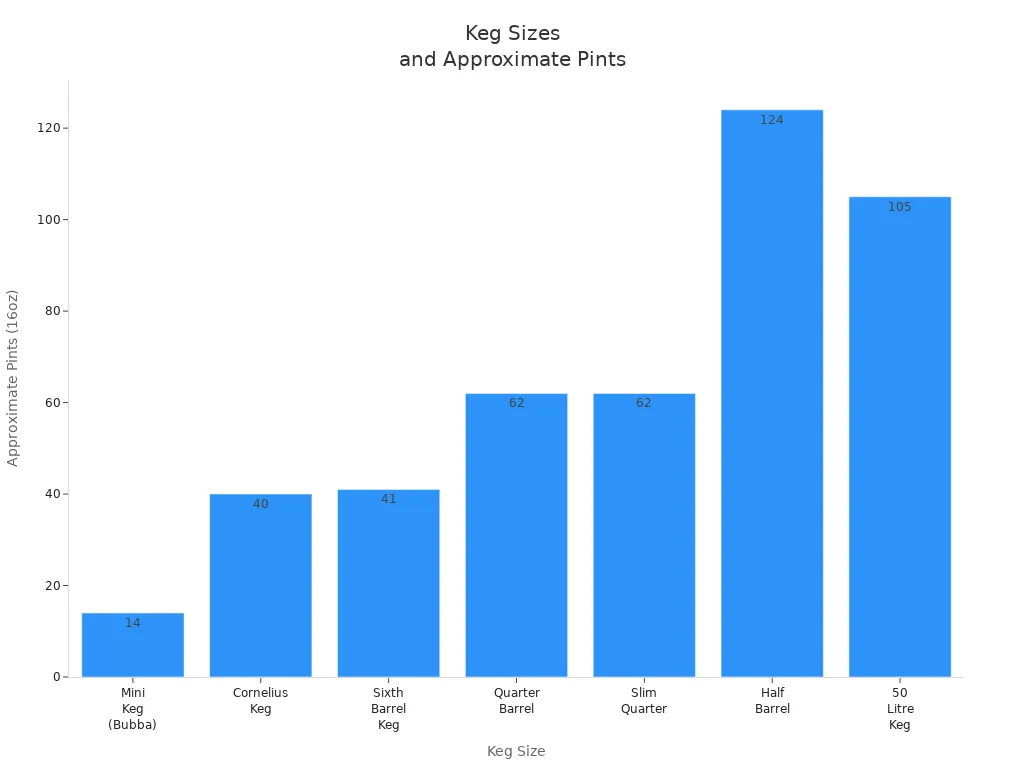
Keg Size | Capacity (gallons) | Approx. Pints (16oz) | Common Uses |
Mini Keg (Bubba) | 1.75 | ~14 | Small parties, portable, tailgating |
Cornelius Keg | 5.0 | ~40 | Homebrewing, small batches |
Sixth Barrel Keg | 5.16 | ~41 | Commercial, limited space, multi-tap |
Quarter Barrel | 7.75 | ~62 | Small parties, limited space |
Slim Quarter | 7.75 | ~62 | Small parties, multi-tap kegerators |
Half Barrel | 15.5 | ~124 | Large events, commercial use |
50 Litre Keg | 13.2 | ~105 | Large events, European commercial |
Tip: Match the keg size to your expected number of servings. This helps you avoid running out or having too much left over.
Think about your space. Large kegs need more room and can be heavy. Smaller kegs fit better in tight spaces and are easier to move. Make sure your kegerator or tap system works with the keg you choose.
![Bar chart comparing keg sizes by approximate number of 16oz pints]()
Avoid common mistakes when choosing a keg:
Guessing guest count or event length.
Ignoring what your guests like to drink.
Forgetting about cooling and storage.
Not checking if you have the right tap or CO2 system.
Skipping clear plans for delivery and pickup.
You can always ask your local brewery or event planner for advice. They help you pick the best keg for your party size, space, and equipment.
You can see the main differences in keg size, weight, and beer count in the table below.
Keg Size | Empty (lbs) | Full (lbs) | Gallons | 12-oz Beers | 16-oz Pints | Best Use |
Half Barrel | 30 | 160 | 15.5 | 165 | 124 | Large events, bars |
Quarter Barrel | 22 | 87 | 7.75 | 82 | 62 | Medium parties |
Sixth Barrel | 15 | ~60 | 5.16 | 55 | 41 | Small gatherings |
![Bar chart comparing number of 12 oz and 16 oz servings for different keg sizes]()
To choose the best keg for your needs:
Match keg size to your guest count and space.
Pick stainless steel for durability.
Check your tap system for compatibility.
Always consider serving size and event size to avoid running out of beers or having too much left over.
FAQ
How long does beer stay fresh in a keg?
You can keep beer fresh in a keg for about 2-3 months if you use CO2 and keep it cold. If you use a hand pump, drink the beer within 1-2 days for the best taste.
Can you reuse a keg for different types of beer?
You can reuse a keg, but you must clean it well first. Rinse the keg with water and use a special cleaner. This keeps flavors from mixing and helps your beer taste fresh.
How do you keep a keg cold at a party?
Place the keg in a large tub.
Add ice around the sides.
Cover the top with a wet towel.
Keep the keg out of direct sunlight.
This method helps your beer stay cold for hours.
What equipment do you need to tap a keg?
Keg Type | Tap Needed |
Standard Keg | Keg coupler |
Mini Keg | Built-in tap |
Cornelius | Ball lock setup |
You also need a CO2 tank for most draft systems.
How do you know when a keg is almost empty?
You will notice the beer flow slows down or stops. The keg feels much lighter when you lift it. Some kegerators have a gauge that shows how much beer is left.